The record in brief In motorsport engineering, ground effect f1 technology utilizes shaped underbody venturi tunnels to generate massive aerodynamic downforce. By accelerating airflow beneath the car, air pressure drops relative to ambient air above, creating suction that pulls the chassis firmly toward the track surface.
Aerodynamic development in Grand Prix racing reached a decisive turning point during the late 1970s. Rather than relying solely on upper-body inverted wings that created substantial aerodynamic drag, automotive engineers harnessed the principles of fluid dynamics to transform the entire vehicle underside into a low-pressure suction chamber. Exploring the history of ground effect f1 machinery reveals how this aerodynamic concept reshaped vehicle performance, driver physiology, and safety regulations.
- Bernoulli principle in action: Underbody venturi tunnels constrict airflow, increasing air velocity and lowering pressure beneath the floor to suck the chassis toward the track.
- The sliding skirt era: Between 1977 and 1980, spring-loaded ceramic and nylon skirts sealed the floor edges against the track, preventing ambient air from spoiling the vacuum.
- Extreme suspension stiffness: To prevent skirt seals from breaking over bumps, teams eliminated suspension travel, subjecting drivers to severe four-G vertical and lateral impacts.
- Regulatory bans and revivals: The FIA enforced a mandatory flat-bottom rule in 1983 to curtail dangerous cornering speeds, before reintroducing modern tunnel floors in the 2022 technical regulations.
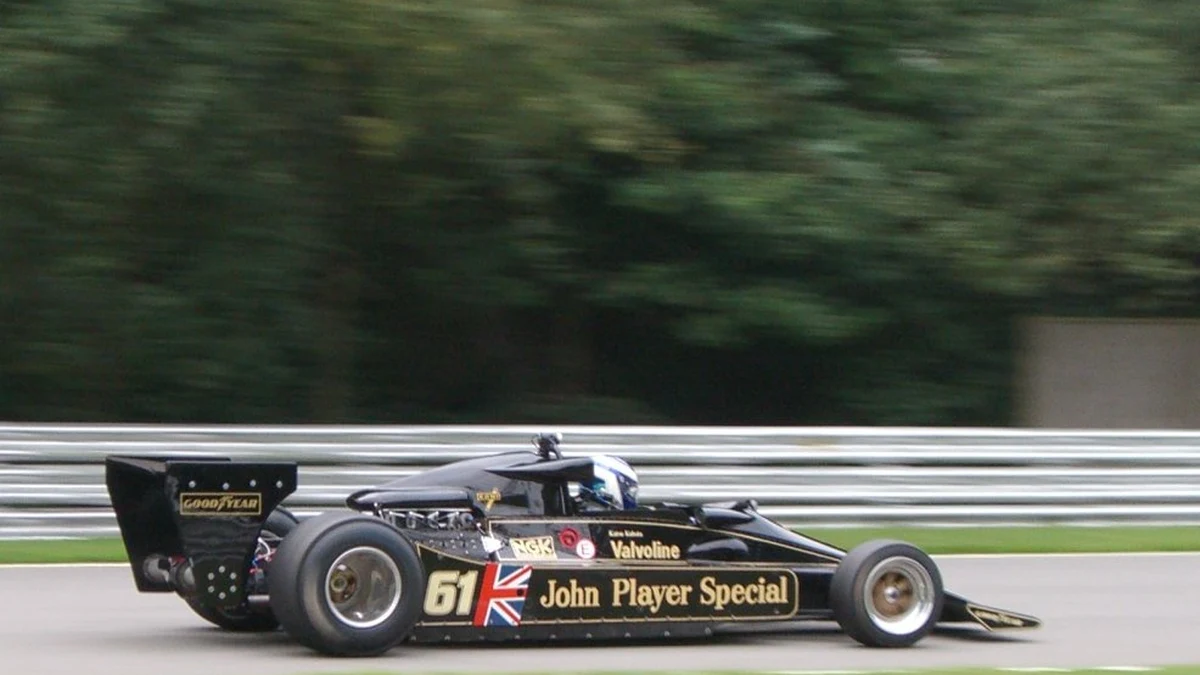
How Do Venturi Tunnels and Fluid Physics Create Ground Effect F1 Downforce?
Venturi tunnels and fluid physics create ground effect f1 downforce through the Bernoulli principle, which states that as the velocity of a moving fluid increases, its static pressure decreases simultaneously. By shaping sidepod floors as converging and diverging ducts, air accelerates under the car, creating a strong partial vacuum.
When atmospheric air enters the converging inlet of the sidepod underbody, the cross-sectional area narrows. To maintain mass flow continuity, the incoming air must accelerate. At the narrowest point of the tunnel, known as the throat, air velocity reaches its maximum, causing static air pressure to drop significantly below ambient atmospheric pressure.
As the air moves toward the rear of the vehicle, the floor expands into a rising diffuser. This expansion decelerates the air smoothly, matching its pressure back to ambient atmospheric conditions at the rear exit. The resulting pressure differential across the entire floor generates hundreds of kilograms of vertical aerodynamic load without producing the massive induced drag penalty associated with traditional top-mounted aerofoils.
On the record: Historical telemetry archives from Federation Internationale de l’Automobile technical evaluations indicate that the Lotus 79 generated more than three times the downforce of conventional flat-bottom cars of the previous season.
How Did Colin Chapman and Team Lotus Pioneer the Concept?
Colin Chapman and Team Lotus pioneered ground-effect racing by integrating shaped internal sidepod profiles and flexible edge seals on the Lotus 78 in 1977. Engineers Peter Wright, Tony Rudd, and Ralph Bellamy discovered the aerodynamic phenomenon during wind tunnel testing at Imperial College London.
During initial wind tunnel tests with scale models, flexible side skirts inadvertently sagged and touched the moving belt floor. The instruments immediately recorded a massive, unexpected surge in downforce. Recognizing the significance of sealing the underside, Chapman initiated Project 78.
The Lotus 78 proved fast but suffered from an aerodynamic center of pressure that shifted unpredictably under braking. Chapman perfected the layout for the 1978 championship with the Lotus 79, often referred to as the Black Beauty. The team integrated fuel tanks behind the cockpit and positioned the cooling radiators horizontally within the sidepods, creating unbroken venturi tunnels from front wheels to rear diffuser.
The Lotus 79 swept the 1978 World Championship, with Mario Andretti and Ronnie Peterson scoring dominant victories across European and North American circuits.
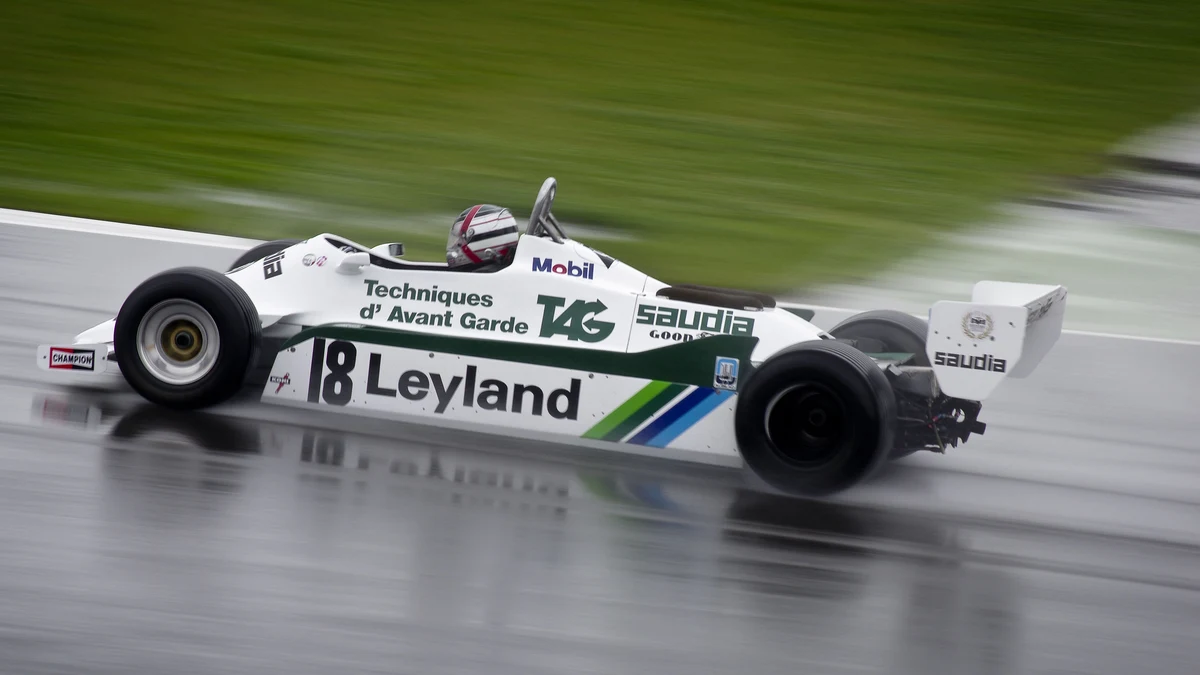
Why Did Sliding Skirts Require Rock-Hard Suspensions?
Sliding skirts required rock-hard suspensions because any vehicle body roll or pitch compromised the vacuum seal between the skirt edge and the asphalt surface. If a skirt lifted or jammed over a track curb, downforce vanished instantaneously, causing sudden high-speed loss of control.
To maintain maximum aerodynamic suction, the gap between the underside edges and the road had to remain perfectly sealed. Teams fitted spring-loaded vertical panels fabricated from aluminium, composite plastic, or ceramic wear strips that dragged continuously along the track surface.
If chassis suspension springs compressed under heavy braking or roll in corners, the skirt mechanisms could bottom out or break. Constructors responded by stiffening suspension spring rates dramatically. By 1981, cars possessed less than one centimeter of total suspension travel, transmitting every asphalt imperfection directly into the driver spine.
The aerodynamic loading produced severe physical consequences:
- Extreme lateral loads: Cornering forces increased from two Gs to over four lateral Gs, straining driver neck muscles to the point of exhaustion.
- Physical disorientation: Drivers suffered vision blur and nausea due to violent vibrations through rigid seat mountings.
- Catastrophic seal failures: Striking a curb could shatter a ceramic skirt tip, instantly venting the underbody vacuum and sending the vehicle off circuit.
How Did Gordon Murray Bypass the 1981 Six-Centimeter Rule?
Gordon Murray bypassed the 1981 six-centimeter rule by designing a hydro-pneumatic suspension system on the Brabham BT49C. The system passed official ground clearance tests while stationary in the pit lane, but lowered the car to the asphalt under aerodynamic loads at speed.
In an effort to slow cornering speeds and eliminate fragile sliding skirts, the governing body mandated a minimum ground clearance of six centimeters for the 1981 season, with fixed rigid skirts. Brabham chief designer Gordon Murray realized that scrutineers only measured clearance when the car stood stationary in the inspection bay.
Murray installed lightweight hydraulic cylinders connected to fluid reservoirs and air bladders. While rolling out of the pit lane, the car stood at the legal six-centimeter ride height. Once the car accelerated on track, downward aerodynamic suction overcame the hydraulic pressure, pulling the car down to touch the track surface and creating a full ground-effect seal. Upon returning to the pit lane, the driver slowed down, and the hydraulic cylinders pushed the car back up to legal ride height before inspection.
| Regulatory Period | Floor Architecture | Edge Sealing Method | Mandatory Ride Height | Landmark Championship Chassis |
|---|---|---|---|---|
| 1977 to 1980 | Full Venturi Sidepod Tunnels | Spring-loaded sliding ceramic/plastic skirts | No minimum ground clearance | Lotus 78 / Lotus 79 / Williams FW07 |
| 1981 to 1982 | Venturi Tunnels with Rigid Skirts | Fixed side skirts (Cheater hydropneumatics) | 6.0 cm statutory minimum clearance | Brabham BT49C / Williams FW08 |
| 1983 to 1993 | Mandatory Flat Bottom (Step floor) | No skirts permitted (Open floor edges) | Controlled reference plane | McLaren MP4/4 / Williams FW14B |
| 1994 to 2021 | Stepped Undertray with Wooden Plank | Vortices and bargeboards (Air curtains) | 10 mm wooden skid block wear test | Ferrari F2004 / Mercedes W11 |
| 2022 to 2026 | Twin Venturi Floor Tunnels | Floor edge winglets and vortex control | Regulated floor stiffness / AOM oscillation limits | Red Bull RB18 / Red Bull RB19 |
Source: Federation Internationale de l’Automobile technical regulation archive and historical Grand Prix engineering logs.
Why Was Ground Effect Banned in 1983 and Brought Back in 2022?
Ground effect was banned in 1983 following a series of violent accidents caused by sudden downforce loss when skirt seals broke. The FIA reintroduced tunnel floors in 2022 to reduce turbulent wake and allow closer wheel-to-wheel racing without relying on fragile sliding skirts.
The tragic accidents of the 1982 season, including the loss of Gilles Villeneuve and career-ending injuries to Didier Pironi, forced immediate regulatory intervention. For 1983, the FIA mandated flat floors between the front and rear wheels, shifting aerodynamic development to massive top-mounted wings and high rear diffusers.
However, over four decades, top-body aerodynamic wings produced massive turbulent wakes (dirty air) that prevented trailing cars from following closely in corners. In 2022, the FIA overhauled technical regulations, reviving shaped underfloor venturi tunnels. Modern ground-effect floors generate clean downforce that directs wake upwards and outwards, allowing cars to follow closely while eliminating the dangerous sliding skirt mechanisms of the past.
For more detailed analyses of motorsport evolution, readers can examine our historical reviews of f1 car evolution, flag marshaling rules in racing flags meaning, or browse the complete Cars and Rulebooks archive.
How we researched this: This technical analysis was compiled from historical engineering papers published by the Society of Automotive Engineers, period technical interviews with Gordon Murray and Peter Wright in Motor Sport Magazine, and official FIA regulatory bulletins from 1977 to 2022.
From the archive mailbag
What is the difference between ground effect and conventional downforce?
Conventional downforce relies on upper-body inverted aerofoil wings that push the car down while creating substantial aerodynamic drag, whereas ground effect uses underbody venturi tunnels to create low-pressure suction beneath the car with significantly lower drag penalties.
Who invented ground effect in Formula One?
Colin Chapman, Peter Wright, Tony Rudd, and Ralph Bellamy at Team Lotus developed the first successful ground-effect Formula One car with the Lotus 78 in 1977, followed by the dominant Lotus 79 in 1978.
Why were sliding skirts banned in Formula One?
Sliding skirts were banned because any damage or lifting of the skirt over curbs caused an immediate, total loss of aerodynamic downforce, leading to catastrophic high-speed crashes when cars lost grip mid-corner.
What is porpoising in modern ground-effect Formula One cars?
Porpoising is a high-speed aerodynamic oscillation where underbody suction pulls the car so close to the asphalt that airflow stalls, causing downforce to vanish and the car to rise on its springs, repeating the cycle rapidly in a violent bouncing motion.
When was the flat-bottom rule introduced in Formula One?
The FIA introduced the mandatory flat-bottom rule for the 1983 season, requiring all cars to have a completely flat underside between the front and rear wheels to eliminate underbody venturi tunnels.