The record in brief The f1 car evolution spans over seven decades of technical transformation, progressing from front-engine ladder-frame roadsters in 1950 to monocoque chassis, aerodynamic wings, ground-effect floors, turbocharged powerplants, and active hybrid systems.
Formula One represents the pinnacle of automotive engineering, where technical regulations continuously clash with designer ingenuity. Understanding the complete f1 car evolution requires examining how sanctioning rules, safety mandates, and aerodynamic breakthroughs turned primitive post-war racers into the fastest circuit machines on earth.
- Engine placement revolution: Cooper proved in 1959 that rear-mid engine placement offered superior weight distribution over traditional front-engine designs.
- Aerodynamic transformation: Colin Chapman introduced inverted aircraft wings in 1968 and ground-effect venturi sidepods in 1977.
- Structural materials: Chassis construction shifted from tubular steel spaceframes to aluminium monocoques in 1962 and full carbon fibre composites in 1981.
- Powertrain eras: Engine formulas transitioned from supercharged 1.5-liter units to 3.0-liter naturally aspirated V8s, 1,000-plus horsepower turbo monsters, high-revving V10s, and 1.6-liter turbo-hybrids.
How Did Early Grand Prix Machines Transition from Front to Rear Engines?
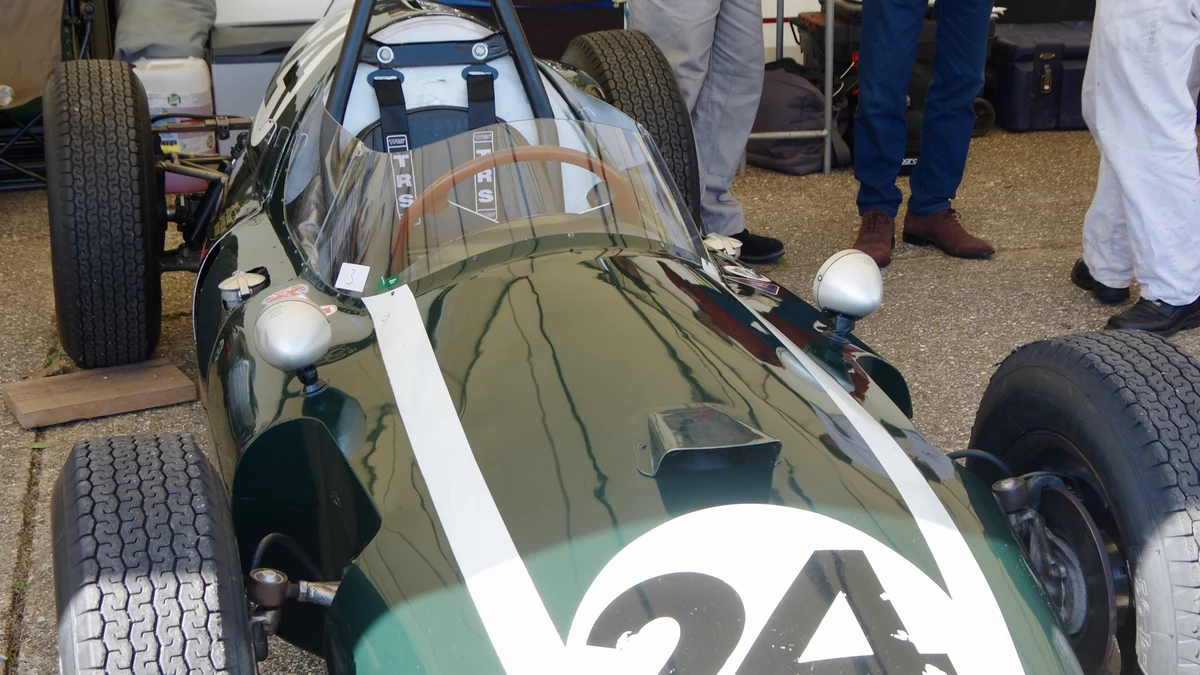
The transition from front to rear engines occurred between 1957 and 1960, initiated by John Cooper and Charles Cooper. Placing the engine behind the driver eliminated the heavy front driveshaft, lowered the center of gravity, reduced aerodynamic frontal area, and produced superior handling balance.
When the Formula One World Championship commenced in May 1950 at Silverstone, the starting grid was dominated by pre-war machinery. Cars such as the Alfa Romeo 158 Alfetta and Maserati 250F placed massive multi-cylinder engines ahead of the cockpit. Drivers sat upright above the driveshaft, wrestling heavy tubular steel chassis with mechanical drum brakes and narrow bias-ply tires.
In the late 1950s, the modest British Cooper Car Company challenged this orthodox architecture. Using lightweight Coventry-Climax four-cylinder engines mounted behind the driver, the Cooper T43 and T51 demonstrated that agility and low polar inertia overcame raw horsepower. Jack Brabham secured back-to-back World Championships in 1959 and 1960 driving rear-engine Coopers, prompting established continental constructors like Ferrari and Lotus to abandon front-engine layouts permanently.
Colin Chapman accelerated this structural revolution in 1962 with the Lotus 25. Chapman replaced the traditional tubular spaceframe with an aluminium sheet monocoque bathtub. This design multiplied torsional rigidity by a factor of three while reducing chassis weight, setting the structural baseline for all future Grand Prix machinery.
On the record: Historical records from the Federation Internationale de l’Automobile show that the 1960 Italian Grand Prix at Monza marked the final Formula One championship victory for a front-engine car, achieved by Phil Hill in a Ferrari 246.
When Did Aerodynamics and Downforce Wings Transform F1 Car Evolution?
Aerodynamics and downforce wings transformed f1 car evolution during the 1968 season, when designers began mounting inverted aerofoil wings directly to suspension uprights. These wings pressed tires into the asphalt, dramatically increasing cornering speeds without requiring added vehicle weight.
Prior to 1968, Grand Prix bodywork served strictly to streamline airflow and reduce aerodynamic drag. Cars resembled polished cigar tubes with exposed suspension components. In early 1968, teams began experimenting with small dive planes and ducktail spoilers to stabilize handling at high speeds.
The aerodynamic revolution progressed through distinct engineering stages:
- Direct suspension mounting (1968-1969): Early wings transmitted downforce directly to unsprung wheel hubs before sanctioning safety bans intervened.
- Chassis-integrated aerofoils (1970-1976): Wings became wider and mounted rigidly to the main monocoque structure alongside front chisel noses.
- Underbody ground effects (1977-1982): Inverted wing sidepods and side skirts generated low pressure beneath the car chassis.
- Diffusers and vortex control (1983-present): Flat floors paired with stepped rear diffusers, bargeboards, and front wing cascade flaps directed airflow around rotating tires.
The aerodynamic arms race escalated rapidly at the 1968 Belgian Grand Prix at Spa-Francorchamps, where Ferrari mounted a high-standing aerofoil wing above the rear suspension. Colin Chapman countered at the subsequent Dutch Grand Prix with towering front and rear wings bolted directly to the wheel hubs of the Lotus 49B. The downward aerodynamic thrust allowed drivers to corner at unprecedented velocities.
However, early tall strut wings were fragile. Catastrophic wing support failures at the 1969 Spanish Grand Prix at Montjuic Circuit resulted in heavy crashes for Lotus teammates Jochen Rindt and Graham Hill. The Commission Sportive Internationale (CSI) intervened immediately, banning high movable wings and mandating that all aerodynamic devices must be rigid, fixed directly to the sprung chassis, and restricted in width and height.
How Did Ground Effect and the Turbocharger Era Redefine Speeds?
Ground effect and turbochargers redefined speeds by generating unprecedented downforce and horsepower during the late 1970s and 1980s. Shaped underbody venturi tunnels sucked cars to the racing surface, while 1.5-liter turbocharged engines exceeded 1,000 horsepower in qualifying trim.
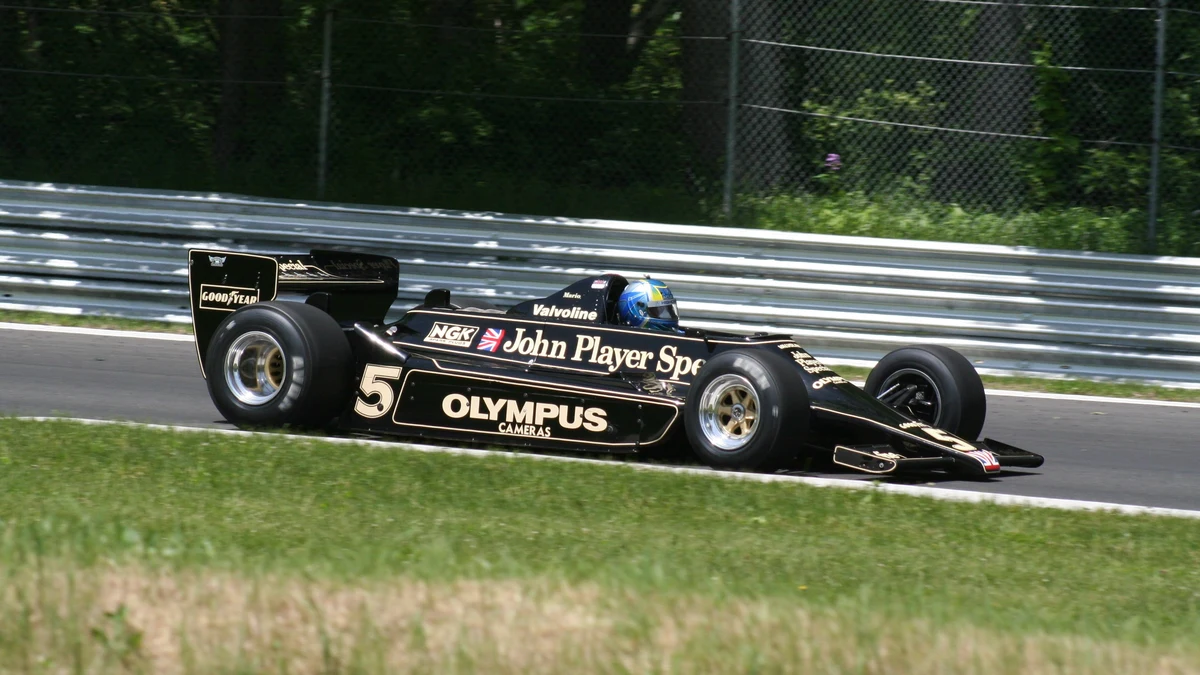
In 1977, Colin Chapman and his engineering team introduced the Lotus 78, followed by the dominant Lotus 79 in 1978. By shaping the car sidepods as inverted aircraft wings and sealing the floor edges with sliding ceramic skirts, the underside created a low-pressure vacuum zone using the Bernoulli principle. The Lotus 79 achieved massive cornering grip with negligible aerodynamic drag penalties, securing the 1978 World Championship for Mario Andretti.
As cornering loads exceeded four lateral Gs, the extreme physical forces strained driver necks and compromised safety. If a sliding skirt stuck or fractured over a curb, downforce vanished instantly, causing sudden high-speed accidents. Sanctioning officials banned movable skirts in 1981 and enforced a mandatory flat-bottom rule between the wheels for the 1983 season, ending the first ground-effect era.
Concurrently, Renault pioneered forced-induction propulsion in 1977 with the RS01, utilizing a 1.5-liter turbocharged V6. While initially plagued by reliability failures, turbo technology matured rapidly. By 1986, turbocharged power units from Honda, BMW, TAG-Porsche, and Ferrari dominated the championship, with BMW qualifying engines reaching an estimated 1,400 horsepower. The governing body phased out turbos at the conclusion of the 1988 season in favor of 3.5-liter naturally aspirated engines on cost and safety grounds.
What Regulatory Changes Shaped the Composite and Modern Hybrid Eras?
Regulatory changes shaped the composite and modern hybrid eras through strict safety cell mandates, aerodynamic standardization, and advanced energy recovery systems. John Barnard introduced the carbon fibre composite monocoque with the McLaren MP4/1 in 1981, revolutionizing driver cockpit survivability.
Following the tragic events at the 1994 San Marino Grand Prix, the FIA introduced sweeping technical changes. The governing body banned electronic driver aids including active suspension, traction control, and automatic gearboxes, while introducing stepped wooden reference planks under the floor to enforce minimum ride heights. In 1998, regulations narrowed track width from 2.0 meters to 1.8 meters and mandated grooved tires to reduce cornering grip deliberately.
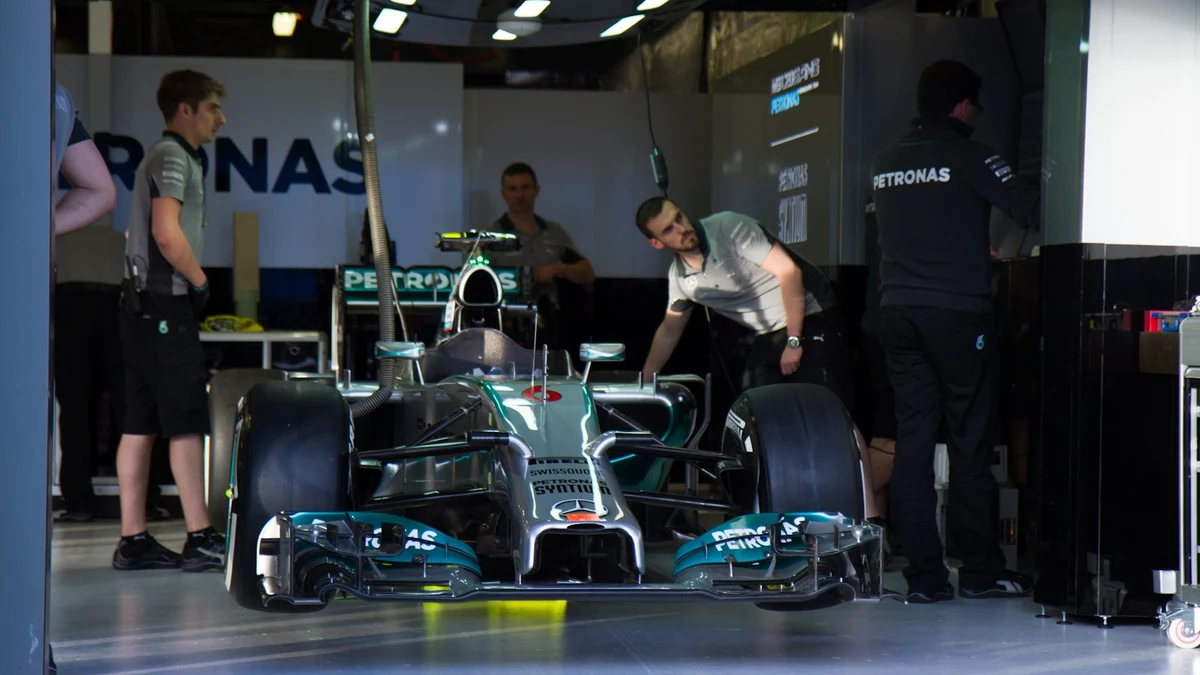
In 2014, Formula One underwent its most radical powertrain shift by replacing naturally aspirated 2.4-liter V8s with 1.6-liter turbocharged V6 power units equipped with complex hybrid Energy Recovery Systems (ERS-K and ERS-H). These power units exceeded fifty percent thermal efficiency, representing the most efficient internal combustion engines in history.
To address aerodynamic turbulence that prevented close wheel-to-wheel racing, the 2022 technical regulations brought back underbody ground-effect venturi tunnels while simplifying upper body wings. As the sport looks ahead to active aerodynamics and sustainable fuels in future rule cycles, the relentless pace of f1 car evolution continues unbroken.
| Era | Chassis Material | Engine Regulation | Key Aerodynamic Feature | Representative Landmark Car |
|---|---|---|---|---|
| 1950 to 1958 | Tubular Steel Spaceframe | 4.5L NA or 1.5L Supercharged | Streamlined cigar body, zero wings | Maserati 250F / Mercedes W196 |
| 1959 to 1967 | Aluminium Sheet Monocoque | 1.5L to 3.0L Naturally Aspirated | Rear-mid engine layout, low drag | Cooper T51 / Lotus 25 |
| 1968 to 1976 | Aluminium Monocoque | 3.0L Naturally Aspirated V8 / Flat-12 | Inverted wings mounted to chassis | Lotus 49B / Tyrrell 003 |
| 1977 to 1982 | Aluminium / Early Carbon | 3.0L NA vs 1.5L Turbocharged | Ground-effect venturi underbody | Lotus 79 / Williams FW07 |
| 1983 to 1988 | Carbon Fibre Composite | 1.5L Turbocharged (Boost limited) | Flat floor, large rear wings | McLaren MP4/4 / Williams FW11 |
| 1989 to 2005 | Carbon Composite Monocoque | 3.5L to 3.0L Naturally Aspirated V10 | High nose cones, stepped undertray | Williams FW14B / Ferrari F2004 |
| 2006 to 2013 | Carbon Composite Monocoque | 2.4L Naturally Aspirated V8 | Complex vortex winglets, blown diffusers | Brawn BGP 001 / Red Bull RB9 |
| 2014 to 2026 | Carbon Composite with Titanium Halo | 1.6L V6 Turbo-Hybrid (MGU-K + MGU-H) | Complex bargeboards (2014), Venturi tunnels (2022) | Mercedes W05 / Red Bull RB18 |
Source: Technical historical archives of the Federation Internationale de l’Automobile and Motor Sport Magazine.
How Has Open-Wheel Heritage Influenced Modern Motorsport Culture?
The aesthetic and technological legacy of open-wheel racing continues to shape automotive enthusiasm worldwide. Enthusiasts celebrate the distinctive silhouettes and historical liveries that defined each milestone in the sport.
Vintage racing liveries, from classic national colors to sponsor designs, established an enduring visual language. Fans exploring historical racing aesthetics often seek apparel inspired by open-wheel heritage, and those interested in period-accurate graphics can review this collection of open-wheel racing apparel.
For additional historical perspective on motorsport traditions, readers can examine our comprehensive guides on british racing green, the origins of what is a livery in racing, track marshal signals in racing flags meaning, or browse the complete Cars and Rulebooks archive.
How we researched this: This technical analysis was compiled from historical technical regulations published by the Federation Internationale de l’Automobile, chassis homologation records, and period technical reports in Motor Sport Magazine archives.
From the archive mailbag
Which car was the first to use a carbon fibre monocoque in Formula One?
The McLaren MP4/1, designed by John Barnard and constructed in collaboration with Hercules Aerospace in 1981, was the first Formula One car to feature a complete carbon fibre composite monocoque chassis.
Why were high aerodynamic wings banned during the 1969 season?
High aerodynamic wings were banned following catastrophic structural failures at the 1969 Spanish Grand Prix at Montjuic, where high-standing wing struts snapped under aerodynamic loads, causing severe accidents for Lotus drivers Graham Hill and Jochen Rindt.
What was the most powerful engine era in Formula One history?
The 1.5-liter turbocharged era of the mid-1980s produced the most powerful engines in the history of the sport, with qualifying powerplants from BMW, Honda, and Renault exceeding 1,200 to 1,400 horsepower before boost limits were enforced.
When did Formula One switch from front-engine to rear-engine cars?
The transition took place between 1957 and 1960. The Cooper Car Company demonstrated the superiority of the mid-to-rear engine configuration with back-to-back world championships in 1959 and 1960, rendering front-engine Grand Prix roadsters obsolete.
Why did the FIA introduce grooved tires in 1998?
The FIA mandated circumferential grooved tires in 1998 to reduce tire contact patch area and intentionally decrease cornering speeds, improving driver safety without restricting engine power output.