The record in brief British racing green is the traditional international motor racing color assigned to British entrants, originating during the 1903 Gordon Bennett Cup held in Athy, County Kildare, Ireland. It does not represent a single standardized paint code, but rather a spectrum of dark green shades established by competition rulebooks from 1903 until 1968.
For more than six decades of international motorsport competition, racing cars did not carry corporate commercial advertisements. Instead, sanctioning bodies mandated national liveries so spectators, timekeepers, and race marshals could identify the home country of each constructor or entrant at high speed. The color known across motorsport as british racing green became the definitive visual signature of United Kingdom constructors, from early twentieth-century road-racing pioneers to the monocoque Grand Prix cars of the 1960s.
- First official appearance: The 1903 Gordon Bennett Cup in County Kildare, Ireland, run by the Automobile Club of Great Britain and Ireland.
- Regulatory allocation: Standardized under the Association Internationale des Automobile Clubs Reconnus (AIACR) international racing color code.
- Technical variation: No single universal color formula exists; shades ranged from Napier olive green to Bentley deep Brunswick green and Lotus bright competition green.
- End of mandatory national colors: The Commission Sportive Internationale (CSI) permitted full commercial sponsorship liveries starting with the 1968 season.
Why Did the 1903 Gordon Bennett Cup Establish Green for Great Britain?
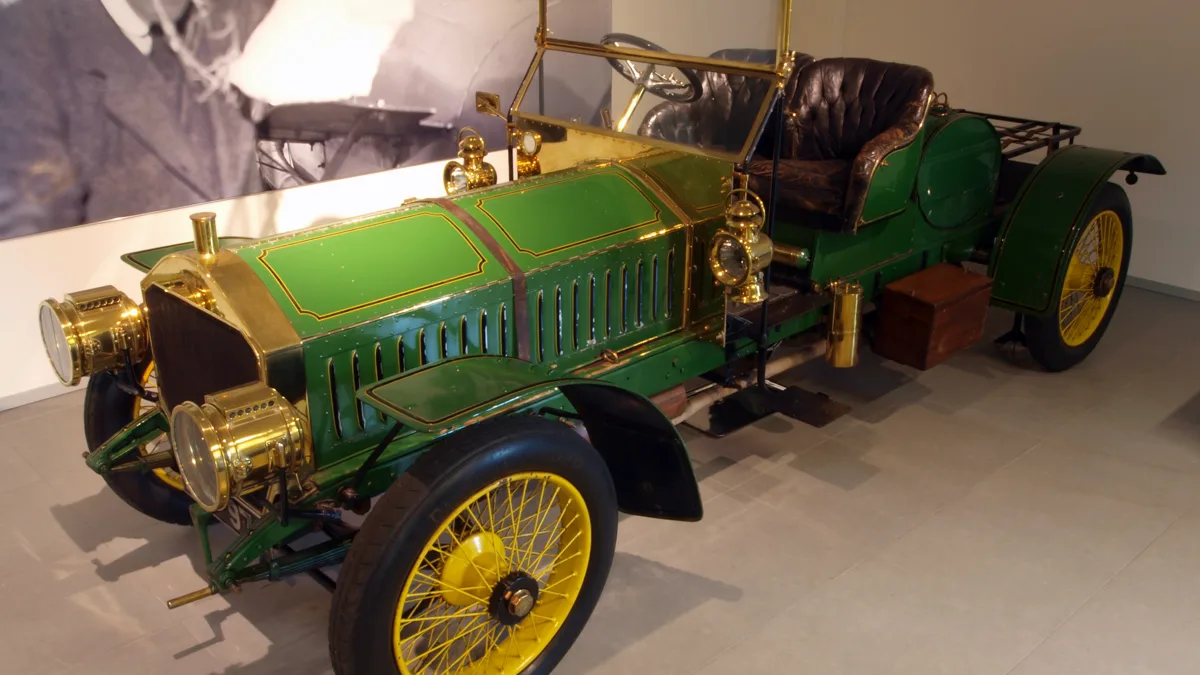
Great Britain adopted green because road racing was illegal on mainland British roads in 1903, requiring the Gordon Bennett Cup to be staged across closed public roads in Ireland. In gratitude to the Irish authorities for passing enabling legislation, British entrant Napier painted its competition cars in shamrock green, permanently establishing green as the national racing color.
The historical record reveals that this color choice resolved an acute legal obstacle. In the 1902 Gordon Bennett Cup, run alongside the Paris-Vienna race, Australian-born driver Selwyn Francis Edge drove an English Napier painted in olive green to victory, earning Great Britain the right to organize and host the 1903 international contest.
According to the official history documented by the Royal Automobile Club, organizers faced an immediate barrier: the 1896 Locomotives on Highways Act imposed a strict 12-mile-per-hour speed limit on public roads throughout England, Scotland, and Wales. To enable the event, the British Parliament enacted the Light Locomotives (Ireland) Act on 27 March 1903, allowing closed-circuit racing across County Kildare, Queen’s County, and County Carlow.
In gratitude to their Irish hosts, the British entrants painted their three Napier race cars in shamrock green for the July 1903 event. While earlier British entries in continental trials had occasionally utilized red or olive tones, the vivid emerald hue fielded on the 327-mile Athy circuit cemented green as the enduring racing identifier for Great Britain.
On the record: Contemporary race accounts published in The Automotor Journal in July 1903 noted that the three British Napier cars were painted in a distinctive emerald green shade to pay respect to the Shamrock Isle, while German entries competed in white and French cars in dark blue.
How Did the AIACR National Racing Colors System Function?
The AIACR national racing colors system functioned as a mandatory regulatory visual code where each competing car was painted in a designated color corresponding to the nationality of its constructor or entrant. This framework ensured instant identification for track marshals, officials, and spectators without relying on sponsor advertisements.
Between 1904 and 1968, the Association Internationale des Automobile Clubs Reconnus and its sporting successor, the Federation Internationale de l’Automobile, maintained this strict livery code across international Grand Prix, endurance, and hillclimb events.
Under these regulations, the assigned color applied to the entrant’s nationality or constructor rather than the nationality of the individual driver. When a British team entered a car in a sanctioned Grand Prix, the chassis was required to display the primary national color, with competition numbers applied in contrasting white or black on designated circular panels.
This system eliminated confusion for corner marshals and grandstand spectators prior to modern electronic timing systems. While France retained blue (bleu de France), Italy was assigned red (rosso corsa), and Germany raced in white (later unpainted silver during the 1930s Grand Prix formula), british racing green served as the sovereign banner for every entrant hailing from the United Kingdom.
Which Shades of British Racing Green Did Constructors Use?
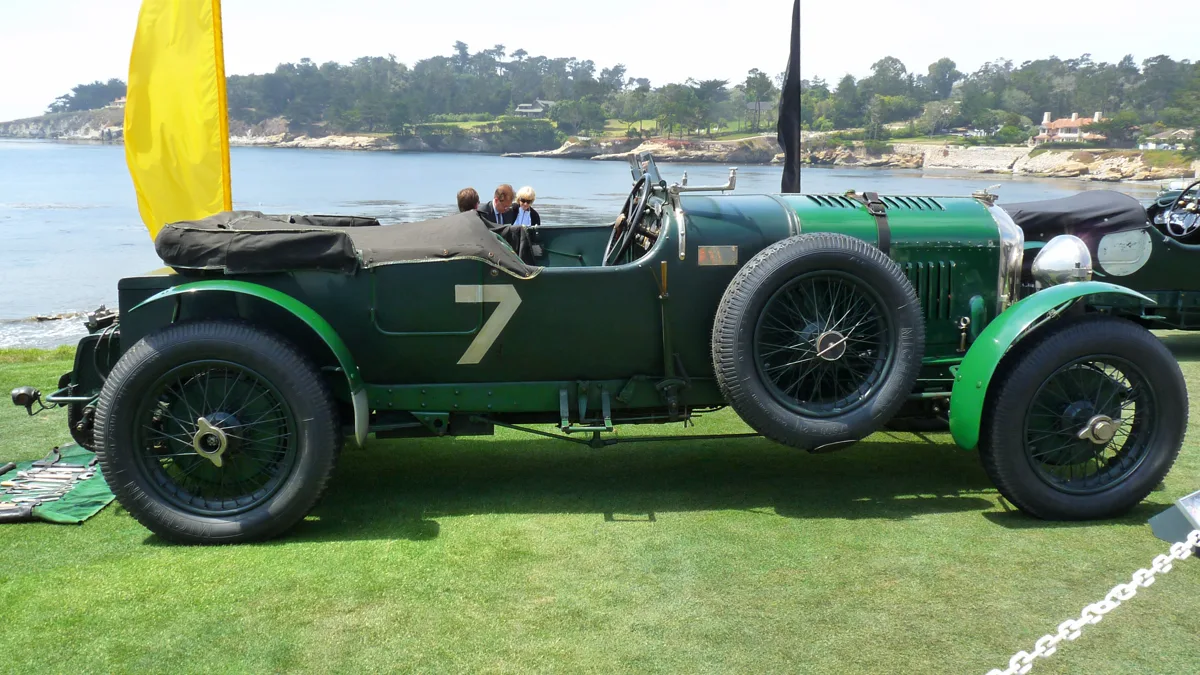
British constructors used a wide range of green shades because competition rulebooks mandated the green hue but never codified a specific chemical formulation or Pantone value. Constructors formulated bespoke shades, ranging from Bentley deep gloss Brunswick green to Aston Martin metallic almond green and Lotus light competition green.
Archival documentation from constructor records demonstrates that each engineering department developed proprietary mixtures. During the 1920s, Bentley established its formidable reputation at the 24 Hours of Le Mans with five overall victories between 1924 and 1930. The factory Bentley 3 Litre, 4.5 Litre, and Speed Six models utilized a deep, near-black Brunswick green. This somber, saturated tone became the public benchmark for pre-war British competition machinery.
Following the Second World War, constructors introduced distinct interpretations suited to new lightweight body panels and team identities:
- Aston Martin: In the 1950s, David Brown’s racing department adopted a lighter metallic sage or almond green for the DBR1, which captured the 1959 24 Hours of Le Mans and the World Sportscar Championship.
- Jaguar: The C-Type and D-Type sports racers that dominated Le Mans from 1951 to 1957 used a rich, high-gloss dark forest green, officially cataloged in Coventry records under proprietary paint formulations.
- Vanwall: Tony Vandervell’s Grand Prix team, which secured the inaugural Formula One Constructors’ Championship in 1958, ran cars in deep dark green with bright yellow nose cones.
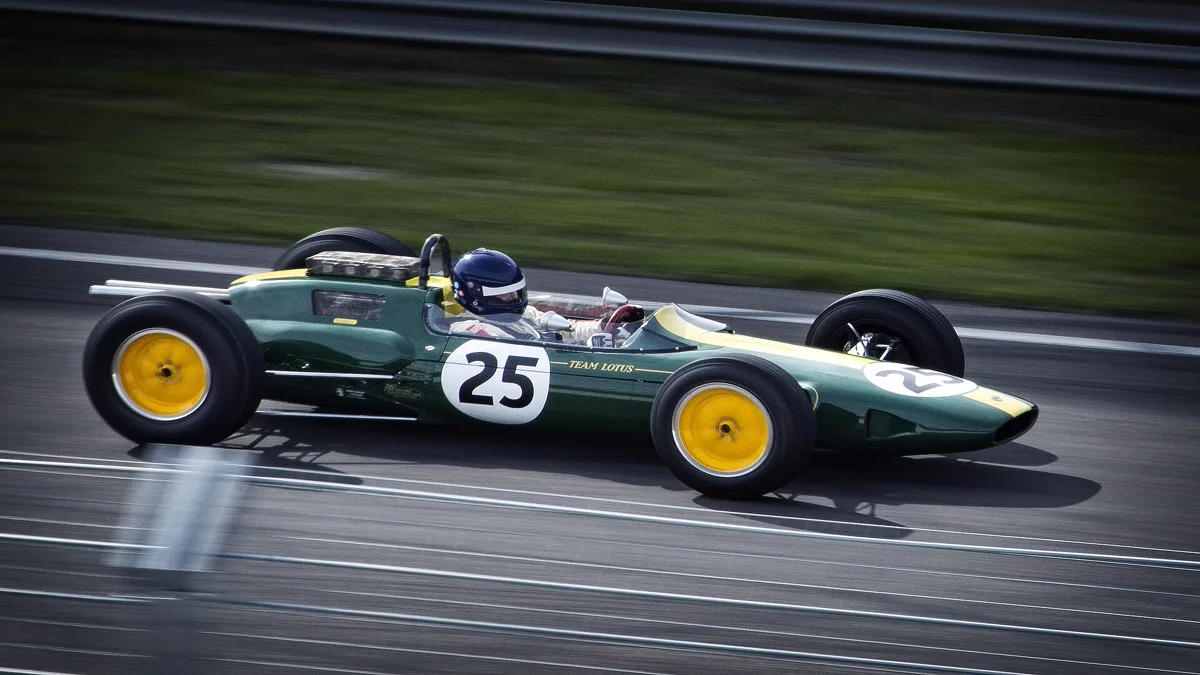
- Team Lotus: Under Colin Chapman, Lotus entered Formula One in 1958 with a brighter, lighter green tone. By 1963, Jim Clark’s championship-winning Lotus 25 featured the celebrated British racing green bodywork paired with a sharp yellow center stripe.
- BRM (British Racing Motors): The Bourne-based team favored a very dark metallic green that appeared almost black in overcast conditions, complemented by orange or dayglo nosebands during the 1.5-liter engine formula.
Where the sources disagree: While automotive historians agree that early Napier racing cars introduced green, period technical journals describe the 1902 Napier as an olive or pale sage tone, whereas the 1903 Gordon Bennett cars were documented as bright emerald. Consequently, both olive green and deep Brunswick green claim historical status as the earliest authentic interpretations.
International Racing Colors by Country (1900 to 1968 Regulations)
To understand the historical context of british racing green, it is necessary to examine how other participating nations were categorized under international competition rulebooks. The following reference table outlines the national racing colors codified under AIACR and early FIA regulations across major motorsport eras.
| Country | Primary Body Color | Numbers / Secondary Trim | First Documented Season | Landmark Example Car | Governing Code Source |
|---|---|---|---|---|---|
| Great Britain | British Racing Green | White numbers; optional yellow nose or stripe | 1903 Gordon Bennett Cup | Napier 50 hp / Lotus 25 | AIACR Appendix Code |
| France | Bleu de France (Medium Blue) | White numbers | 1900 Gordon Bennett Cup | Bugatti Type 35 / Matra MS80 | Automobile Club de France |
| Italy | Rosso Corsa (Racing Red) | White numbers | 1907 Targa Florio / Grand Prix | Alfa Romeo P2 / Ferrari 156 | AIACR National Register |
| Germany | White / Silver (bare metal) | Red numbers on white; black on silver | 1900 Gordon Bennett / 1934 Eifelrennen | Mercedes SSKL / Silver Arrows W125 | AIACR / ONS National Code |
| United States | White with Blue lengthwise stripes | Blue numbers on white body | 1951 24 Hours of Le Mans | Cunningham C-4R / Ford GT40 Mk II | CSI Appendix J Section |
| Belgium | Yellow (Jaune de Belgique) | Black numbers | 1904 Gordon Bennett Cup | Ferrari 250 TR (Ecurie Francorchamps) | Royal Automobile Club de Belgique |
| Netherlands | Orange | White numbers with black borders | 1930s Grand Prix trials | Porsche 718 (Carel Godin de Beaufort) | KNAC Historical Archive |
| Switzerland | Red body with White bonnet | Black numbers on white roundels | 1930s Voiturette racing | Maserati 4CLT (Scuderia Filipinetti) | Automobile Club Suisse |
Source: AIACR International Racing Code (1904 to 1946) and FIA CSI Appendix J Technical Archive (1947 to 1968).
How Did the 1968 CSI Sponsorship Rule End Mandatory National Colors?
The 1968 CSI sponsorship rule ended mandatory national racing colors by officially permitting commercial brand advertising on exterior body panels to offset escalating team budgets. This change led constructors like Team Lotus to replace British racing green with commercial liveries, shifting motorsport identity from national flags to commercial sponsors.
The requirement to run in national competition liveries remained in force until the start of the 1968 Formula One season, when rising constructor operational costs forced the FIA sporting committee to reconsider its commercial guidelines.
At an extraordinary meeting held in late 1967, the Commission Sportive Internationale voted to amend the sporting code, permitting commercial sponsor advertising on the exterior surfaces of competition cars for the 1968 championship. Team Lotus became the first major constructor to abandon national colors entirely. At the 1968 Spanish Grand Prix at Jarama, Colin Chapman presented the Lotus 49 finished in the red, white, and gold colors of the Gold Leaf cigarette brand.
Within two seasons, the vast majority of Formula One and World Sportscar Championship teams adopted commercial liveries funded by oil companies, consumer goods, and tobacco manufacturers. While private entrants such as Rob Walker Racing continued to campaign in dark blue with a white stripe and Tyrrell retained dark blue in homage to French partner Elf, the mandatory era of british racing green on front-running Grand Prix machinery came to an effective close.
Today, national racing colors survive primarily in historic motorsport events like the Goodwood Revival and the Le Mans Classic, where cars must appear in their original period liveries, and through heritage road vehicle paint palettes that celebrate this six-decade era of international competition. For more historical analyses of racing liveries and color systems, explore the Liveries & Colors section of the archive.
From the archive mailbag
Why did Great Britain use green instead of red, white, and blue?
When international competition colors were first assigned in 1900, the colors of the Union Jack were already claimed: France selected blue, Germany took white, and the United States initially registered red. Great Britain had no established color until 1902 when Napier won the Gordon Bennett Cup in an olive green car. When Britain hosted the 1903 contest in Ireland, the team painted the cars shamrock green as a tribute to Ireland for enacting the legislation that made the race legal.
What is the official Pantone or RGB code for British racing green?
There is no single official Pantone, RAL, or hex code for British racing green. Neither the AIACR nor the FIA ever specified an exact chemical formula or color swatch, requiring only that the bodywork be green. Individual constructors developed proprietary formulations, ranging from Bentley’s deep Brunswick green to Lotus’s lighter competition green and Aston Martin’s metallic almond green.
Which was the first British team to win a World Championship in green?
Vanwall became the first British constructor to win the Formula One World Constructors’ Championship in 1958, campaigning cars finished in dark green with yellow nose bands. In 1959 and 1960, the Cooper Car Company won back-to-back world titles with rear-engine cars finished in British racing green with white racing stripes.
When did Formula One officially stop requiring national racing colors?
The Commission Sportive Internationale (CSI) officially relaxed the restriction against commercial sponsorship on competition cars before the start of the 1968 season. Team Lotus debuted the first non-national commercial livery on a works Formula One car at the 1968 Spanish Grand Prix, running in Gold Leaf red, gold, and white.
Did Bentley and Jaguar use the same green paint at Le Mans?
No. Bentley used a traditional gloss Brunswick green with strong black undertones during its 1920s campaigns, whereas Jaguar in the 1950s utilized a bespoke, richer forest green formulation specifically created for the C-Type and D-Type sports racing bodies.
How we researched this: seasons, results and specifications were checked against series archives and published period sources. An AI system assisted with the rough draft; the history was verified and rewritten by an editor.
Sources: Royal Automobile Club Archive, Federation Internationale de l’Automobile Historical Technical Regulations, 24 Hours of Le Mans Official ACO Archives, and Motor Sport Magazine Historical Register (1924 to 1968).