The record in brief The racing flags meaning across professional motorsport defines the universal visual communication system operated by track marshals and race control. Flags signal track hazards, penalties, track conditions, and race endings to drivers traveling at speeds where radio communication alone is insufficient.
Before the introduction of electronic cockpit dashboard telemetry and full-course safety lights, flag signals served as the sole real-time communication channel between race officials and drivers. Understanding the definitive racing flags meaning requires analyzing how different governing bodies, including the FIA, NASCAR, and IndyCar, developed distinct rules for flag colors and display methods across motorsport history.
- Universal safety signals: Green signifies a clear track, yellow mandates caution without overtaking, and red immediately halts the competition.
- Disciplinary flags: The solid black flag orders an entrant to the pits, while the black-and-orange flag warns of mechanical danger.
- Series discrepancies: The white flag indicates a slow service vehicle in Formula One, but signals the final lap of competition in NASCAR and IndyCar.
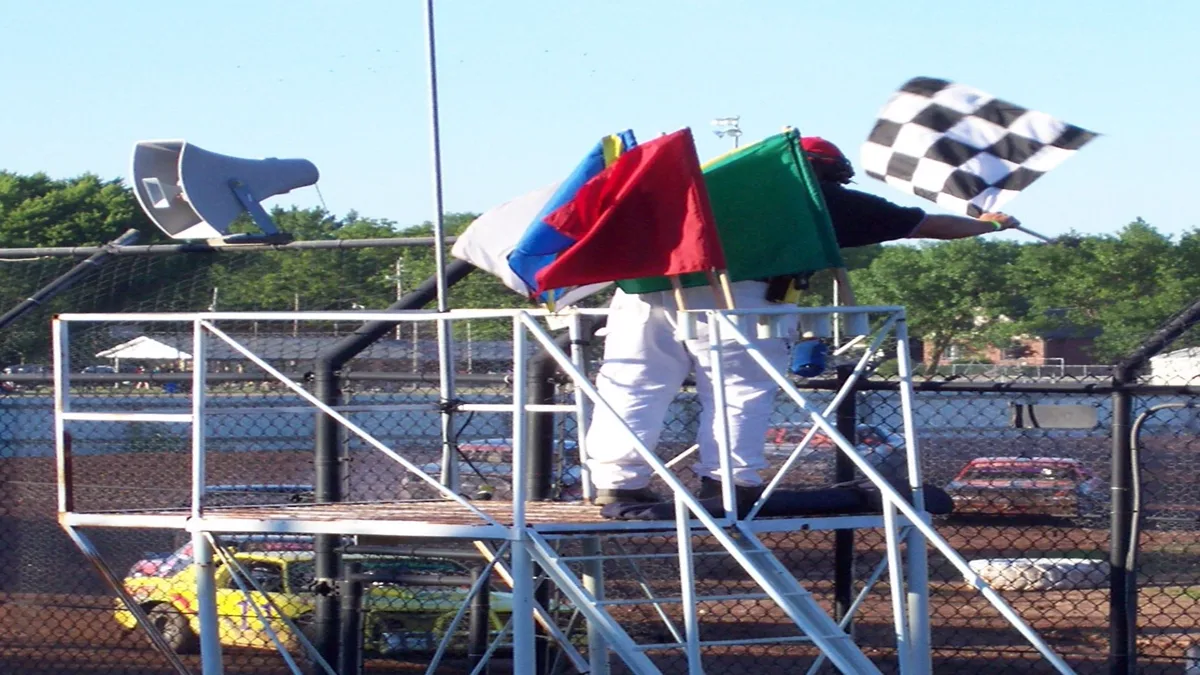
- The checkered flag origin: Emerged in early twentieth-century American road trials before becoming the universal symbol for race conclusion.
Where Did the Racing Flag Signaling System Originate?
The racing flag signaling system originated in railway signaling and nineteenth-century horse racing before being adapted by early automotive clubs around 1900. Race organizers needed an instantaneous visual code visible through dust clouds and oil spray to warn approaching drivers of disabled vehicles and track hazards.
In early point-to-point road contests such as the Paris-Rouen trial of 1894 and the Gordon Bennett Cup events, marshals stationed at railroad crossings and village checkpoints waved colored banners to instruct drivers to slow down or bring their machines to a complete halt.
When permanent paved circuits opened in the 1900s, such as the Indianapolis Motor Speedway and Brooklands in England, sanctioning bodies formally codified color-coded flags into their sporting rulebooks. As documented in early Royal Automobile Club publications, standardizing flag dimensions and colors eliminated confusion among international competitors.
On the record: According to the historical archives of the Federation Internationale de l’Automobile, Appendix H to the International Sporting Code (ISC) was established to establish standardized international flag protocols for all sanctioned road courses worldwide.
How Do Yellow and Red Safety Warning Flags Function?
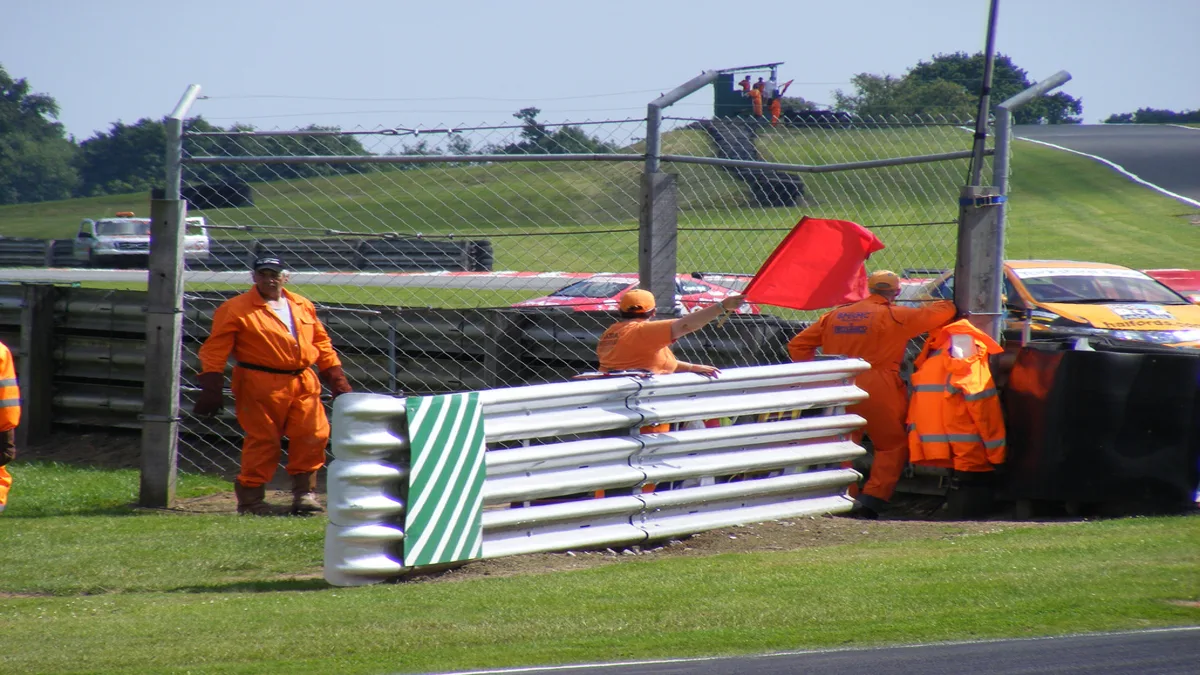
Yellow and red safety warning flags function as mandatory hazard commands that require immediate driver compliance to protect stranded competitors and track workers. A single waved yellow flag indicates danger ahead and forbids overtaking, while double waved yellow flags require drivers to reduce speed substantially and prepare to stop.
Under current FIA regulations, as of the 2026 season, a double yellow flag displayed at any marshaling post mandates that an entrant must reduce lap time noticeably and be prepared to take evasive action around an obstruction on the racing surface.
When conditions deteriorate due to severe collisions, heavy rain, or structural barrier damage, race directors display the red flag. The red flag halts the race immediately, requiring all active competitors to proceed cautiously to the pit lane or the starting grid without overtaking.
What Are the Differences Between F1 and NASCAR Racing Flags?
The differences between F1 and NASCAR racing flags center on the white flag, blue flag enforcement, and yellow flag pacing procedures. In Formula One, a white flag warns drivers of a slow-moving emergency vehicle or safety car on the track, whereas in NASCAR and IndyCar, the white flag signifies that the race leader has started the final lap.
Blue flag regulations also diverge significantly between American oval racing and international Grand Prix circuits. In Formula One, marshals display the blue flag to backmarker cars about to be lapped, mandating that they must yield position within three marshaling sectors under penalty.
In contrast, NASCAR uses the blue flag with a diagonal yellow stripe as an informational courtesy flag on oval tracks, encouraging slower cars to yield the preferred line without enforcing a mandatory pass-through penalty. Understanding these distinct series rules is vital for interpreting the comprehensive racing flags meaning across disciplines.
How Do Officials Use Black and Disciplinary Racing Flags?
Officials use black and disciplinary racing flags to summon offending drivers to the pit lane for sporting infractions or mechanical dangers. The solid black flag, displayed alongside the car’s competition number, orders the driver to report to the penalty box or team garage immediately.
Motorsport rulebooks incorporate specialized variations of the black flag to address specific track scenarios:
- Solid black flag: Signifies immediate disqualification or an enforced drive-through penalty for severe driving infractions or ignoring previous official warnings.
- Black flag with orange disc (Meatball flag): Warns an entrant that their vehicle suffers from mechanical damage, such as a loose body panel or fluid leak, requiring an immediate pit stop for repair.
- Diagonally divided black and white flag: Acts as a direct unsportsmanlike conduct warning for track-limits violations, aggressive blocking, or dangerous driving maneuvers.
- Black flag with white cross: Utilized in NASCAR to notify a competitor that scoring has ceased for their car due to failure to heed a previous black flag within three laps.
| Flag Symbol | Formula One (FIA ISC) Meaning | NASCAR Oval Meaning | First Codified Era |
|---|---|---|---|
| Solid Green | Track is clear; racing underway | Green flag start or restart | 1900s Early road trials |
| Single Yellow | Hazard beside track; no overtaking | Caution period; pace car deployed | 1910s Speedway era |
| Double Yellow | Hazard blocking track; prepare to stop | Local caution on road courses | 1960s FIA Appendix H |
| Solid Red | Session suspended; return to pits | Race halted; stop on track or pits | 1920s Grand Prix code |
| Solid Blue | Mandatory yield to faster car behind | Informational move-over advisory | 1950s World Championship |
| Solid White | Slow vehicle or safety car on circuit | One lap remaining to finish | 1909 Indianapolis 500 |
| Yellow and Red Striped | Deteriorated grip, oil, or water on track | Debris or fluid on track surface | 1950s Sports car racing |
| Checkered (Black and White) | Session or race officially concluded | Race completed; winner declared | 1906 Vanderbilt Cup |
Source: FIA International Sporting Code Appendix H and Official NASCAR Rulebook Reference Archive.
What Is the Documented History of the Checkered Finish Flag?
The checkered finish flag originated in American automotive endurance contests during the early 1900s, with the earliest documented use occurring at the 1906 Vanderbilt Cup on Long Island, New York. Photographic evidence confirms flag marshals waving a black-and-white checked cloth to signal the conclusion of the race to winner Louis Wagner.
Historians debate why the checkered pattern was selected over a solid color. The predominant historical consensus holds that high-contrast alternating squares provided maximum visual contrast against dusty dirt roads, bright sky backgrounds, and diverse spectator clothing.
Alternative folklore suggests the checkered pattern derived from nineteenth-century Midwest bicycle races or trackside dining tablecloths, but period photographic records from 1906 through the 1909 opening events at Indianapolis provide the first verifiable documentary proof. To explore more foundational motorsport rules, read our historical analysis of british racing green and visit the Races & Rules section.
From the archive mailbag
What does a white flag mean in Formula One versus NASCAR?
In Formula One, a waved white flag warns competitors that a slow-moving vehicle, such as an official safety car, medical vehicle, or damaged competitor, is present on that sector of the track. In NASCAR and IndyCar, the white flag is waved from the starter stand to signal that the race leader has begun the final lap of the race.
What is the meaning of the yellow and red striped flag?
The yellow and red striped flag, commonly known as the surface flag or oil flag, warns drivers of deteriorated track adhesion caused by spilled engine oil, radiator coolant, standing water, or loose debris scattered across the racing line.
What happens if a driver ignores a black flag?
If a competitor ignores a black flag, race control will disqualify the car from the official classification. In series like NASCAR, official timing and scoring stops recording the car’s laps after three laps, and the sanctioning body may impose severe fines and future grid bans.
Who invented the checkered flag in racing?
While no single inventor holds a registered patent, the checkered flag was first documented in photographic records at the 1906 Vanderbilt Cup in New York by race starter Fred Wagner. Its high-contrast alternating pattern was selected to stand out against dusty road backgrounds.
What does the black and orange circle flag indicate?
Commonly referred to as the Meatball flag, the black flag with an orange circle in the center informs a driver that their car has mechanical damage or fluid leaks that pose a safety hazard, requiring an immediate pit stop for inspection or repair.
How we researched this: seasons, results and specifications were checked against series archives and published period sources. An AI system assisted with the rough draft; the history was verified and rewritten by an editor.
Sources: FIA International Sporting Code Appendix H, NASCAR Official Rulebook Archive, Indianapolis Motor Speedway Historical Records, and Motor Sport Magazine Rules Compendium.