The record in brief Group B rally was a premier World Rally Championship regulatory formula from 1982 to 1986, characterized by minimal technical restrictions, lightweight composite chassis, permanent four-wheel drive, and turbocharged engines exceeding five hundred horsepower before safety concerns prompted its abolition.
Between 1982 and 1986, international rallying experienced its most intense period of technological development. The Fédération Internationale du Sport Automobile (FISA) introduced liberal technical regulations that allowed manufacturers to construct purpose-built racing prototypes with minimal production requirements. Examining the history of group b rally competition provides an objective look at how four-wheel drive, advanced composites, and extreme turbocharging transformed stage rallying.
- Liberal homologation rules: Manufacturers were required to build only two hundred road-legal production examples to qualify, with subsequent evolution models requiring just twenty units.
- Drivetrain revolution: Audi pioneered permanent all-wheel drive, which quickly became mandatory for all competitive machinery alongside mid-engine chassis layouts.
- Extreme power-to-weight ratios: Spaceframe chassis constructed from tubular steel, Kevlar, and carbon fibre weighed under one thousand kilograms while turbocharged engines surpassed five hundred horsepower.
- The 1986 cancellation: Following high-profile accidents in Portugal and Corsica, FISA president Jean-Marie Balestre announced the termination of Group B for the 1987 season in favor of production-based Group A rules.
How Did FISA Homologation Rules Create Group B Rally Prototypes?
FISA homologation rules created group b rally prototypes by lowering the production requirement from four hundred units under previous Group 4 rules to only two hundred road cars. In addition, manufacturers could homologate an evolution variant each year by producing just twenty specialized examples.
In 1982, motorsport governing body FISA reorganized international competition categories into Group A (production touring cars requiring 5,000 units), Group B (grand touring and rally prototypes requiring 200 units), and Group C (endurance sportscars).
The two-hundred-unit threshold enabled major automotive manufacturers to build low-volume, specialized spaceframe vehicles with exotic lightweight materials. Once the base two hundred cars were certified, engineers could introduce radical aerodynamic wings, widened tracks, and higher-boost turbochargers through the twenty-car evolution loophole.
Unlike showroom passenger vehicles, these competition machines featured carbon-Kevlar body shells, central transfer cases, and modular suspension assemblies designed for rapid fifteen-minute gearbox changes during service intervals.
On the record: Official homologation records from the Federation Internationale de l’Automobile confirm that Homologation Form B-201 was issued to the Audi Quattro on January 1, 1982, inaugurating the category.
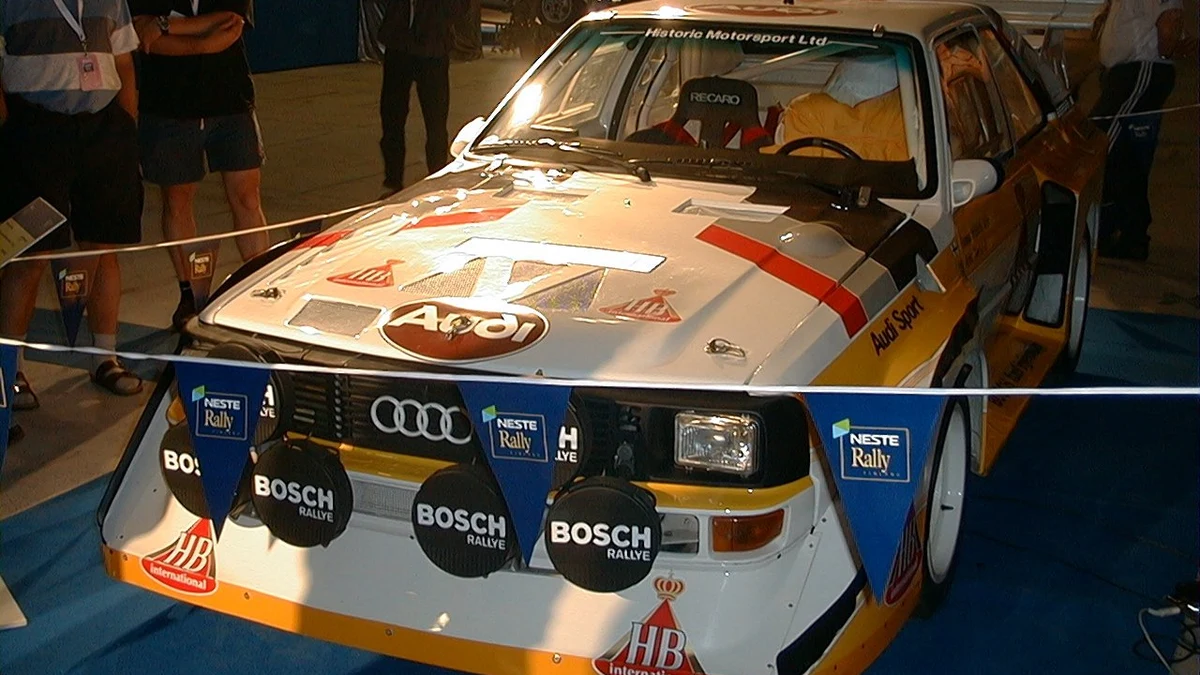
How Did Audi Four-Wheel Drive Revolutionize Stage Rallying?
Audi four-wheel drive revolutionized stage rallying by demonstrating that superior traction on loose gravel, snow, and mud overcame the weight penalty of front-mounted all-wheel-drive hardware. Audi claimed the World Rally Championship Manufacturers title in 1982 and 1984.
Prior to 1980, four-wheel drive was considered too heavy and mechanically complex for high-speed rallying. Audi chassis engineer Jörg Bensinger developed an all-wheel-drive system using a hollow secondary gearbox shaft, allowing drive to be sent simultaneously to front and rear differentials without a heavy transfer case.
Debuting in late 1980 and fully homologated for Group B in 1982, the front-engine Audi Quattro dominated gravel stages. Drivers Hannu Mikkola, Stig Blomqvist, and Michèle Mouton demonstrated that the car could accelerate out of slippery corners at speeds rear-wheel-drive rivals like the Lancia 037 could not match.
However, the long front overhang and nose-heavy weight distribution created handling challenges on tight asphalt hairpin turns, paving the way for the next generation of mid-engine designs.
What Made Mid-Engine Prototypes Like the 205 T16 and Delta S4 So Fast?
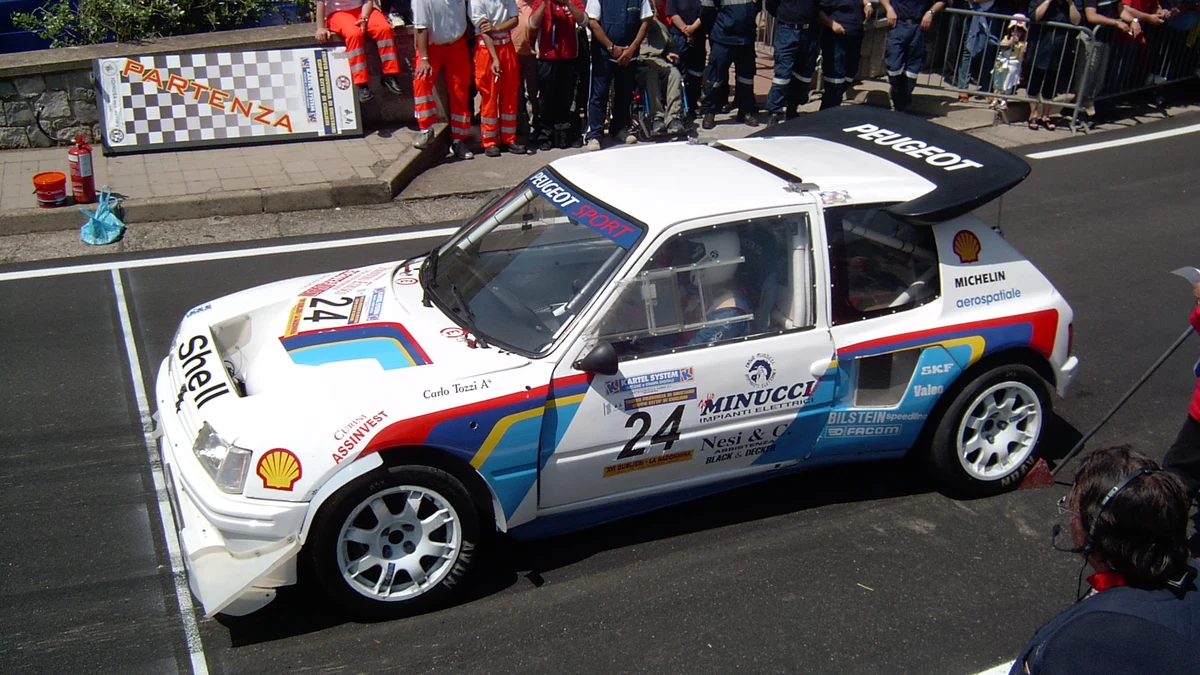
Mid-engine prototypes achieved extraordinary speeds by combining centralized weight distribution, four-wheel drive, and advanced forced-induction systems. Positioning the engine behind the crew eliminated understeer and optimized chassis agility over jumps and through technical corners.
In 1984, Peugeot Talbot Sport under the direction of Jean Todt introduced the Peugeot 205 Turbo 16. The car featured a transverse four-cylinder turbocharged engine mounted behind the driver, paired with an epicyclic center differential that split torque between front and rear axles. Ari Vatanen and Timo Salonen drove the 205 T16 to dominant world titles in 1985 and 1986.
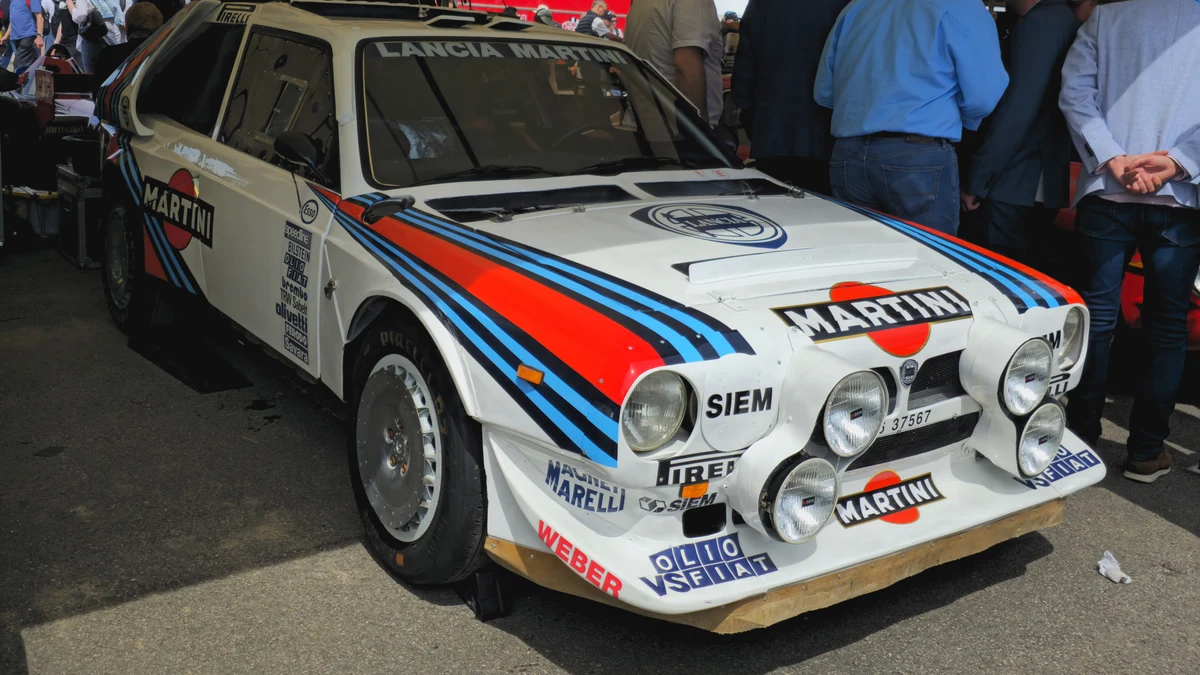
Lancia responded in late 1985 with the technologically complex Delta S4. To eliminate turbo lag at low engine speeds, Lancia engineers created a twin-charging system, connecting an engine-driven Volumex Roots supercharger for low-end torque with a massive KKK turbocharger that took over at higher revolutions. The Delta S4 produced over five hundred and fifty horsepower in asphalt trim.
Other manufacturers followed with specialized designs:
- Ford RS200: Designed by Formula One aerodynamicists Tony Southgate and John Wheeler, featuring a bespoke Ghia fiberglass body and front-mounted gearbox.
- MG Metro 6R4: Utilized a naturally aspirated 3.0-liter V6 developed by Williams Grand Prix Engineering to deliver instantaneous throttle response.
- Austin Rover packaging: Placed radiator cooling and spare tires centrally to maintain a low polar moment of inertia.
For more technical context on how forced induction reshaped Grand Prix racing in the same era, explore our guide on f1 car evolution or review track safety protocols in racing flags meaning.
What Factors Led to the Sudden Ban of Group B at the End of 1986?
The sudden ban of Group B resulted from escalating vehicle speeds that exceeded human reaction times and inadequate spectator crowd control on special stages. Catastrophic accidents during the 1986 season forced governing bodies to intervene on safety grounds.
At the 1986 Rally de Portugal in Sintra, a privately entered Ford RS200 left the road into an uncontrolled crowd area, resulting in multiple spectator fatalities and injuries. Top factory drivers withdrew from the event in protest against unsafe spectator management.
Two months later, on May 2, 1986, during the Tour de Corse in Corsica, Lancia factory driver Henri Toivonen and co-driver Sergio Cresto were killed when their Delta S4 plunged down a ravine and caught fire. Within hours of the accident, FISA president Jean-Marie Balestre convened an emergency meeting and announced that Group B, along with the proposed Group S prototype formula, would be abolished at the conclusion of the 1986 championship.
| Constructor | Landmark Model | Homologation Year | Engine & Induction Layout | Championship Honors |
|---|---|---|---|---|
| Audi | Sport Quattro S1 / E2 | 1984 to 1985 | 2.1L Front Turbocharged Inline-5 (500+ hp) | 1982 and 1984 WRC Manufacturers Champion |
| Lancia | 037 Rally / Delta S4 | 1982 to 1985 | 1.8L Mid Twin-Charged Inline-4 (550 hp) | 1983 WRC Manufacturers Champion (037) |
| Peugeot | 205 Turbo 16 / Evo 2 | 1984 to 1985 | 1.8L Mid Turbocharged Inline-4 (500 hp) | 1985 and 1986 WRC Drivers and Manufacturers Champion |
| Ford | RS200 | 1986 | 1.8L Mid Turbocharged Inline-4 (450 hp) | 1986 Rally Sweden 3rd Place Podium |
| Austin Rover | MG Metro 6R4 | 1985 to 1986 | 3.0L Mid Naturally Aspirated V6 (410 hp) | 1985 Lombard RAC Rally 3rd Place Podium |
Source: World Rally Championship historical archives and Federation Internationale de l’Automobile records.
How Did the World Rally Championship Transition to Group A?
The World Rally Championship transitioned to Group A in 1987 by requiring competition cars to be derived from mass-produced passenger models with a minimum production volume of five thousand road cars. This regulatory change restored mechanical safety margins and promoted production-car road relevance.
Manufacturers adapted rapidly to the new framework. Lancia dominated the early Group A era with the five-door Delta HF 4WD and Integrale, capturing six consecutive World Manufacturers Championships between 1987 and 1992.
Japanese constructors including Toyota, Subaru, and Mitsubishi entered the championship with all-wheel-drive turbocharged sedans like the Celica GT-Four, Impreza 555, and Lancer Evolution, establishing a technological foundation that shaped production performance cars for three decades.
To explore more historical racing technical regulations, visit our analysis of f1 car evolution or browse the complete Races and Rules archive.
How we researched this: This technical history was compiled from official Federation Internationale de l’Automobile sporting bulletins, period stage reports in Motor Sport Magazine and Autosport, and technical documentation preserved by the World Rally Championship heritage archives.
From the archive mailbag
Why was Group B banned in 1986?
FISA banned Group B following severe accidents at the 1986 Rally de Portugal and the fatal crash of Henri Toivonen and Sergio Cresto at the Tour de Corse, determining that car speeds had exceeded safe margins for stage rallying.
How many road cars were needed to homologate a Group B rally car?
Manufacturers had to produce a minimum of two hundred identical road-going production units to homologate a base Group B car, and twenty units for evolution models.
What was the most successful car of the Group B era?
The Peugeot 205 Turbo 16 was the most successful Group B car, winning sixteen World Rally Championship events and consecutive Manufacturers and Drivers World Championships in 1985 and 1986.
How much horsepower did Group B rally cars produce?
By the 1986 season, top evolution cars like the Audi Sport Quattro S1 and Lancia Delta S4 produced between five hundred and five hundred and fifty horsepower from their turbocharged and twin-charged engines.
What was Group S that was planned to replace Group B?
Group S was a proposed prototype formula intended for 1987 that required only ten production units, but it was canceled along with Group B in May 1986 in favor of production-based Group A regulations.