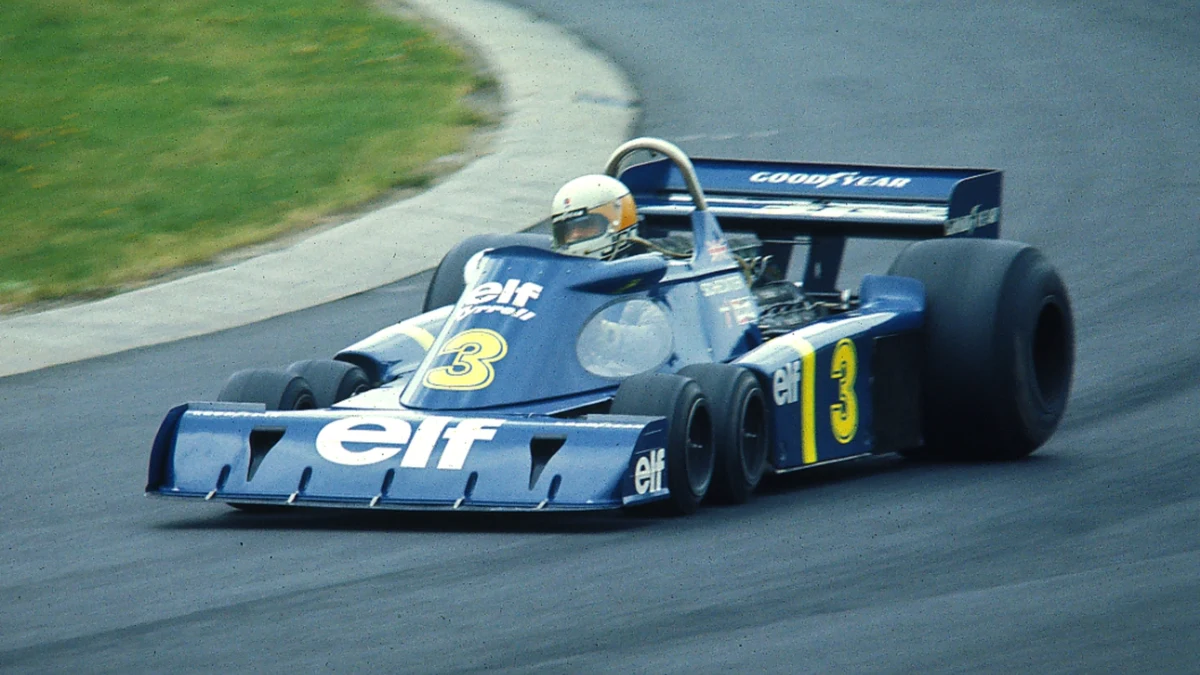
The record in brief A six wheel f1 car was an innovative engineering concept designed during the 1970s, most famously realized in the Tyrrell P34. Designer Derek Gardner introduced four small ten-inch front wheels to reduce aerodynamic lift and frontal drag rather than purely increasing mechanical contact area.
Few competition machines captured public imagination like the multi-wheeled Grand Prix prototypes of the late 1970s and early 1980s. Understanding the definitive history of the six wheel f1 car requires examining the aerodynamics behind Derek Gardner original vision, the race victory of the Tyrrell P34, and the regulatory ban that sealed the concept fate.
- Aerodynamic objective: Gardner designed small ten-inch front wheels to tuck completely behind a bluff front nose cone, reducing aerodynamic drag by an estimated forty horsepower equivalent.
- Historic victory: The Tyrrell P34 remains the only six-wheeled car to win a championship Grand Prix, scoring a dominant one-two finish at the 1976 Swedish Grand Prix.
- Alternative configurations: While Tyrrell used four steered front wheels, March, Ferrari, and Williams experimented with four driven rear wheels to improve traction and ground-effect packaging.
- Regulatory prohibition: The FIA formally banned multi-wheeled chassis in late 1982, mandating that all Formula One cars must compete with exactly four wheels.
Why Did Derek Gardner Design a Six Wheel F1 Car?
Derek Gardner designed the six-wheeled chassis primarily to minimize aerodynamic drag and eliminate front-end lift. By substituting standard thirteen-inch front tires with bespoke ten-inch tires hidden behind a full-width front wing, airflow over the cockpit and rear wing improved significantly.
During the mid-1970s, virtually every competing team in Formula One relied on the ubiquitous Ford-Cosworth DFV V8 engine paired with a Hewland gearbox. Because engine power was identical across the field, Tyrrell technical director Derek Gardner sought an aerodynamic advantage that rivals could not easily copy.
Gardner calculated that exposed standard front tires created immense aerodynamic turbulence and lift. By designing a bespoke four-wheel front steering rack utilizing ten-inch wheels, the tires remained entirely enclosed within the front aerodynamic fairing. This design reduced frontal area and generated cleaner airflow to the rear wing, yielding a calculated top-speed advantage on high-speed straights.
To compensate for the smaller contact patch of individual ten-inch tires, Gardner utilized four wheels on two steered axles. This configuration preserved total front braking surface area and rubber contact with the asphalt while providing built-in redundancy during heavy braking zones.
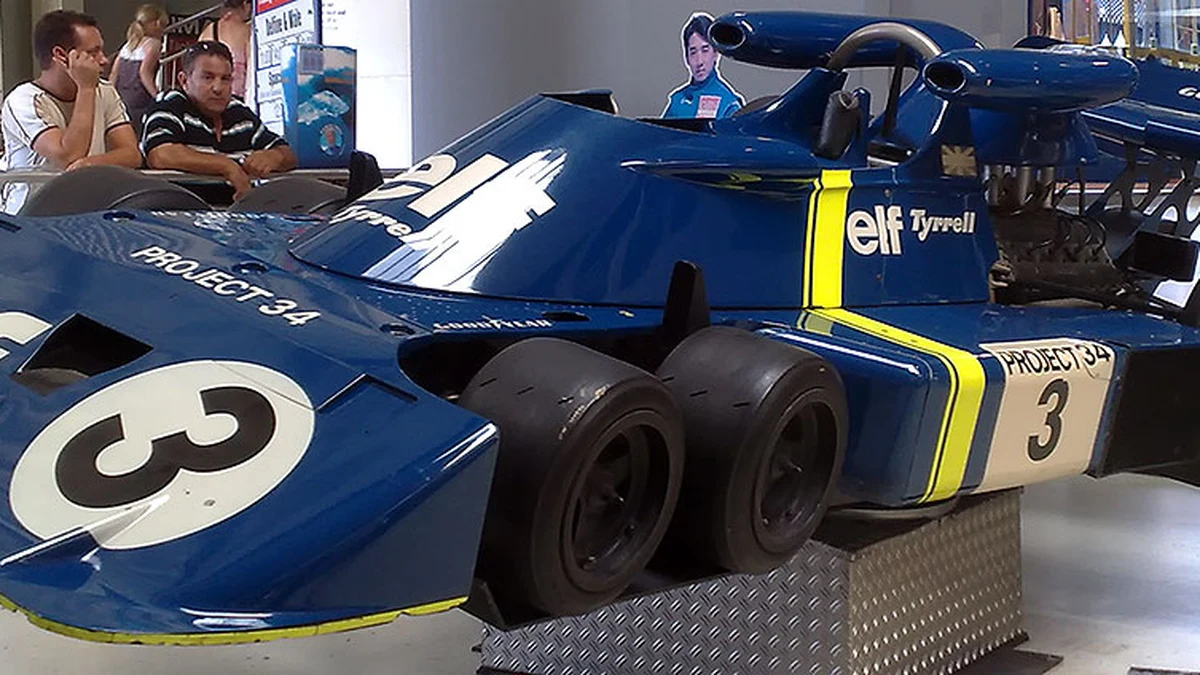
On the record: Historical engineering logs from the Tyrrell Racing Organisation confirm that project Project 34 was developed under strict secrecy at Gardner home workshop in early 1975 before its public unveiling at the Heathrow Hotel in September 1975.
What Was the Competition Record of the Tyrrell P34?
The competition record of the Tyrrell P34 includes one championship victory, fourteen podium finishes, and third place in the 1976 World Constructors Championship. Jody Scheckter and Patrick Depailler demonstrated the speed of the concept across European circuits during the 1976 season.
The P34 made its race debut at the 1976 Spanish Grand Prix at Jarama driven by Patrick Depailler. Scheckter and Depailler quickly established the car as a legitimate frontrunner. The high-water mark of the multi-wheel project arrived at the 1976 Swedish Grand Prix at Anderstorp Circuit, where Scheckter claimed pole position and led Depailler across the finish line for a historic one-two victory.
Despite this success, the 1977 season proved frustrating for the team. Goodyear, focused on battling Michelin in a fierce tire development war, neglected the development of the bespoke ten-inch front tires while advancing regular thirteen-inch rear compounds. The resulting grip disparity induced chronic front-end understeer that ruined the car competitiveness.
For additional perspective on how regulation shifts influenced chassis architectures during this decade, readers can consult our guide on f1 car evolution or explore historical track marshal signaling in racing flags meaning.
Myths Versus Facts Surrounding Multi-Wheeled Grand Prix Cars
Several persistent misconceptions surround the history and performance of multi-wheeled Grand Prix cars. Analyzing period telemetry data and contemporary technical reports separates historical reality from enthusiast folklore.
- Myth: The extra wheels were added solely for mechanical grip. Fact: Derek Gardner primary motivation was aerodynamic penetration and drag reduction. The four small front wheels were designed to be hidden behind the front air dam to lower air resistance.
- Myth: Drivers could not see where to place the front wheels. Fact: Tyrrell cut transparent perspex viewing windows into the cockpit side panels, allowing drivers to monitor front tire wear and apex curbing accurately.
- Myth: The P34 was banned immediately because it was considered dangerous. Fact: The P34 completed two full seasons in 1976 and 1977 without being declared illegal. Tyrrell voluntarily abandoned the design for 1978 due to Goodyear tire supply stagnation.
- Myth: Tyrrell was the only constructor to build a six-wheeler. Fact: March, Ferrari, and Williams all constructed operational six-wheeled test prototypes between 1976 and 1982.
How Did March, Ferrari, and Williams Adapt the Six-Wheel Idea?
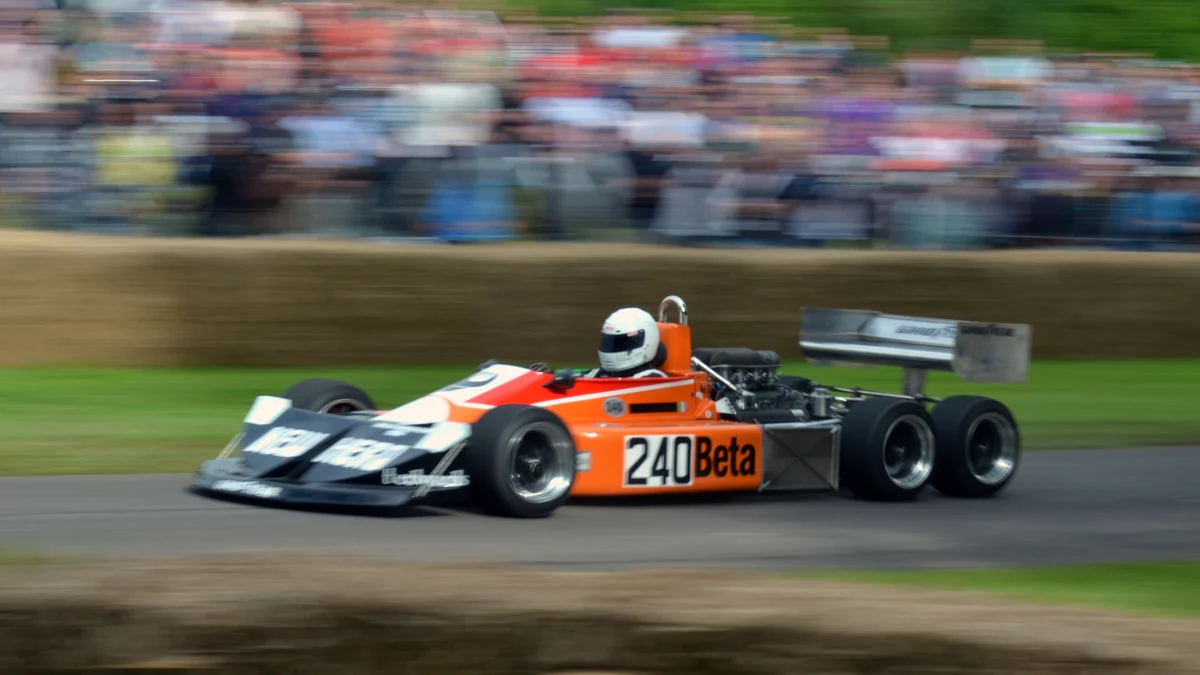
March, Ferrari, and Williams adapted the six-wheel concept by placing four driven wheels at the rear axle rather than the front. This rear tandem configuration aimed to improve mechanical traction and maximize ground-effect venturi floor area.
In late 1976, Robin Herd at March Engineering developed the March 2-4-0. Rather than using small front steering wheels, Herd placed four standard sixteen-inch driven wheels at the rear using a custom gearbox casing. While the car suffered transmission flex during initial tests, the concept demonstrated immense traction potential in hillclimb events.
Ferrari tested an experimental 312T6 in 1977, featuring four rear wheels mounted side-by-side on a single rear axle. However, the width exceeded allowable vehicle dimensions, and severe suspension loading led Ferrari to abandon further testing.
Patrick Head and Frank Dernie at Williams created the most refined six-wheeler in 1982 with the Williams FW08B. By using four driven rear wheels, Williams created an exceptionally long ground-effect underbody with unbroken venturi sidepods. In testing, Jonathan Palmer set blistering lap times, proving the concept was devastatingly fast.
| Constructor | Chassis Designation | Tested Seasons | Wheel Arrangement | Drive Configuration | Championship Result |
|---|---|---|---|---|---|
| Tyrrell | P34 / P34B | 1976 to 1977 | 4 Front (Steered), 2 Rear | Rear-wheel drive (2 wheels) | 1 Win, 14 Podiums |
| March | 2-4-0 | 1976 to 1977 | 2 Front, 4 Rear (Tandem) | Four-wheel drive (4 rear wheels) | Testing and Hillclimbs only |
| Ferrari | 312T6 | 1977 | 2 Front, 4 Rear (Dual-mounted) | Rear-wheel drive (4 rear wheels) | Private Fiorano tests only |
| Williams | FW07D / FW08B | 1981 to 1982 | 2 Front, 4 Rear (Tandem) | Four-wheel drive (4 rear wheels) | Testing only (Banned prior to debut) |
Source: Historical race archives of Motor Sport Magazine and FIA Technical Commission records.
Why Did Governing Officials Ban Multi-Wheeled Race Cars?
Governing officials banned multi-wheeled race cars to contain soaring cornering speeds, prevent escalating development costs, and eliminate complex tire manufacturing burdens. The FIA codified the four-wheel rule ahead of the 1983 Formula One world championship season.
When the Williams FW08B demonstrated overwhelming pace in late 1982 testing, the FIA realized that other teams would be forced to develop four-wheel-drive six-wheelers. The cost of re-engineering gearboxes and fabricating complex drive shafts would have bankrupted smaller privateer entrants.
Beyond development costs, tire suppliers refused to manufacture multiple bespoke tire sizes for different team configurations. To ensure sporting fairness and maintain safety standards, the FIA revised Article 1 of the Technical Regulations for 1983, stating unequivocally that cars must possess four wheels, of which only two may be steered and only two driven.
For more technical breakdowns of classic racing rules and vintage aesthetics, explore our articles on what is a livery in racing, British motorsport heritage in british racing green, or the Cars and Rulebooks category.
How we researched this: This historical investigation was compiled from contemporary race reports in Motor Sport Magazine, official FIA sporting bulletins from 1975 to 1983, and technical retrospective documentation preserved by the Tyrrell Racing heritage trust.
From the archive mailbag
Did a six wheel f1 car ever win a Grand Prix?
Yes. The Tyrrell P34 won the 1976 Swedish Grand Prix at Anderstorp with Jody Scheckter taking victory ahead of teammate Patrick Depailler in second place.
Why did Tyrrell stop using the six-wheeled P34?
Tyrrell abandoned the six-wheeled concept after the 1977 season because tire supplier Goodyear stopped developing the bespoke ten-inch front tires, leaving the car with severe understeer against rivals using modern front compounds.
When did the FIA formally ban six-wheeled cars from Formula One?
The FIA introduced a formal ban ahead of the 1983 season, revising the technical rulebook to require that all Formula One cars must have exactly four wheels, with only two driven wheels.
How did drivers steer the four front wheels on the Tyrrell P34?
The Tyrrell P34 used a complex mechanical steering rack connected via progressive linkages to four front suspension assemblies, allowing all four front ten-inch wheels to turn synchronously.
Was the Williams six-wheeler faster than conventional cars?
Yes. In late 1982 testing at Donington Park, the Williams FW08B with four driven rear wheels demonstrated remarkable cornering grip and exceptional straight-line acceleration before the FIA banned the concept.