The record in brief The silver arrows (Silberpfeile) is the celebrated moniker given to the dominant German Grand Prix racing cars built by Mercedes-Benz and Auto Union between 1934 and 1939, and later revived by Mercedes-Benz in 1954 and modern Formula One competition.
The pre-war Grand Prix era between 1934 and 1939 represented a period of unprecedented technological advancement and fierce national rivalry. Unpainted, polished aluminium machines from Mercedes-Benz and Auto Union reached speeds exceeding two hundred miles per hour on narrow public roads. Exploring the true history of the silver arrows requires separating romantic paddock folklore from documented engineering reality.
- The 750-kilogram formula: Introduced by the AIACR in 1934, the maximum weight rule aimed to restrict engine size, but instead spurred lightweight metallurgical breakthroughs.
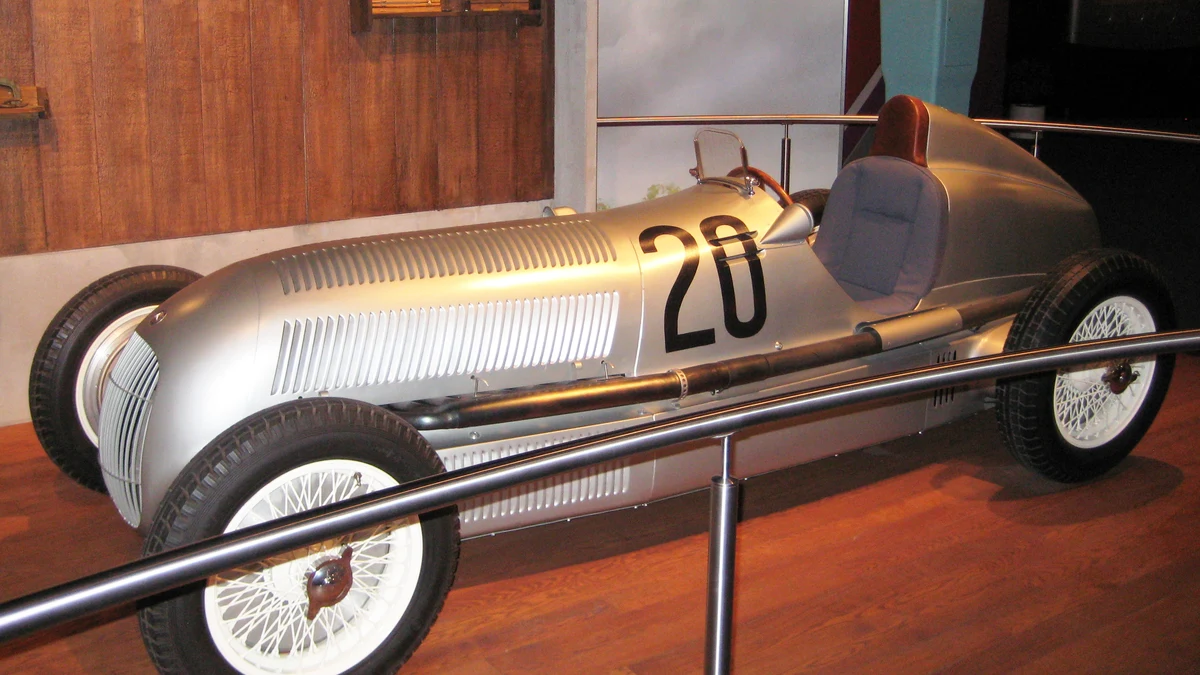
- The paint-scraping legend: Mercedes team manager Alfred Neubauer claimed mechanics scraped white lead paint off the W25 overnight to meet weight limits, though contemporary evidence shows bare aluminium was used earlier.
- Technological dominance: Mercedes-Benz and Auto Union cars featured supercharged multi-cylinder engines producing over six hundred horsepower with independent suspensions and streamlined bodywork.
- Post-war legacy: The silver livery returned in 1954 with the championship-winning Mercedes-Benz W196, continuing through modern factory Grand Prix entries.
How Did the Silver Arrows Myth of Scraped Paint Originate?
The silver arrows paint-scraping myth originated in the 1958 memoirs of Mercedes team manager Alfred Neubauer. Neubauer recounted that before the 1934 Eifelrennen at the Nurburgring, the new Mercedes W25 weighed 751 kilograms against a statutory 750-kilogram maximum limit, prompting mechanics to scrape away white paint overnight.
According to Neubauer dramatic account, driver Manfred von Brauchitsch suggested scraping the lead-based white paint down to the bare aluminium sheet metal, saving exactly one kilogram and allowing the car to pass scrutineering the following morning.
However, modern motorsport historians have questioned this narrative. Contemporary race documentation, technical bulletins, and newspaper articles from June 1934 make no mention of a late-night weight crisis or scraped paint. In addition, radio broadcasts at the 1932 Avusrennen had already described Manfred von Brauchitsch streamlined Mercedes-Benz SSKL as a silver arrow due to its unpainted aluminium skin.
Auto Union also entered its new mid-engine Type A Grand Prix cars at the same 1934 Eifelrennen in bare polished aluminium without controversy, as eliminating paint was a practical weight-saving measure adopted across the German automotive industry.
On the record: Archival research published by the Mercedes-Benz Classic Archive notes that while Neubauer colorful story became popular culture, bare metal bodywork was primarily an engineering choice to optimize power-to-weight ratios.
How Did Mercedes-Benz and Auto Union Differ in Engineering?
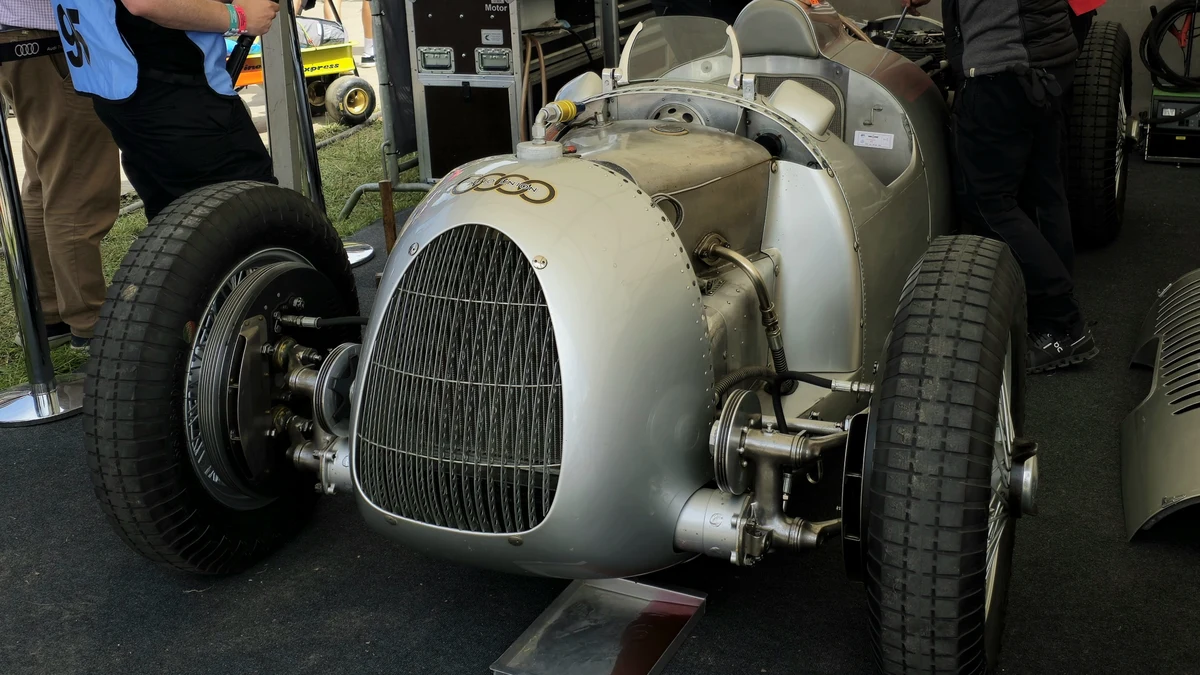
Mercedes-Benz and Auto Union differed fundamentally in chassis architecture and engine placement. Mercedes-Benz refined front-engine layouts with supercharged straight-eight engines, while Auto Union pioneered mid-engine design with supercharged V16 powerplants positioned behind the cockpit.
Under chief engineer Rudolf Uhlenhaut, Mercedes-Benz developed the W25, W125, and W154. The 1937 Mercedes W125 featured an ultra-stiff nickel-chrome molybdenum steel oval tubular frame paired with soft suspension travel and de Dion rear axles, producing a staggering 646 horsepower from a 5.6-liter supercharged engine.
In contrast, Ferdinand Porsche designed the Auto Union Type A through Type C with a massive 6.0-liter V16 engine mounted amidships. This mid-engine layout placed the driver forward, reducing polar moment of inertia but requiring exceptional throttle sensitivity to prevent snap oversteer. Driving legends like Bernd Rosemeyer mastered the fearsome machine to challenge Mercedes supremacy across Europe.
To examine how national colors originally distinguished international competition teams before commercial liveries, review our comprehensive breakdown of british racing green and our detailed guide on what is a livery in racing.
What Made These Pre-War Grand Prix Machines So Dominant?
These pre-war machines achieved dominance through immense state-backed research funding, advanced aviation fuels, and cutting-edge metallurgical alloys. Mercedes-Benz and Auto Union pushed engine outputs beyond six hundred horsepower, a figure unmatched in Grand Prix racing until the turbo era of the 1980s.
Engineers utilized specialized fuel mixtures containing alcohol, benzol, acetone, and nitrobenzene to prevent pre-ignition and cool the supercharged intake charges. Exotic alloys, including magnesium-aluminium electron and duralumin, kept chassis weights below the stringent 750-kilogram threshold.
The technical developments yielded extraordinary performance milestones:
- Speed records: Streamlined record cars achieved over 268 miles per hour on closed autobahn stretches in 1938.
- Chassis dynamics: Early adoption of de Dion rear suspensions reduced unsprung weight and eliminated swing-axle wheel tuck.
- Forced induction: Roots-type and vane-type superchargers delivered boost pressures exceeding twenty pounds per square inch.
- Braking systems: Massive finned drum brakes with cockpit-adjustable hydraulic balance controlled deceleration from extreme speeds.
How Did Mercedes Revive the Silver Identity in 1954?
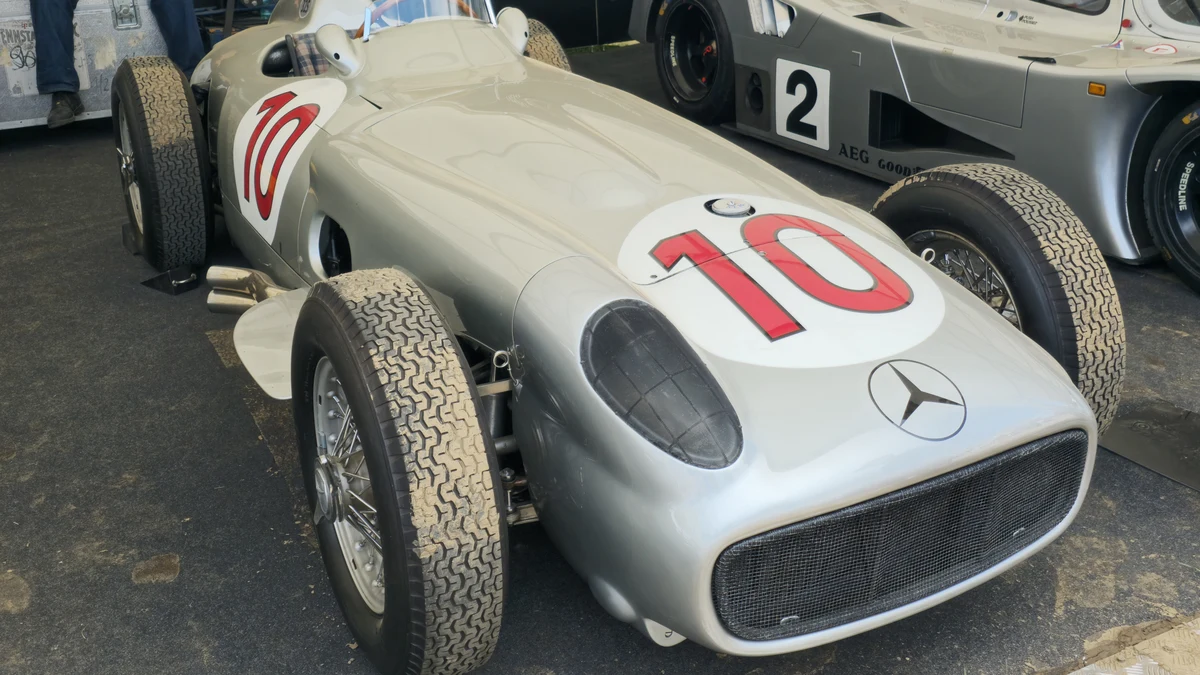
Mercedes-Benz revived the silver identity in 1954 by entering the Formula One World Championship with the technologically advanced W196. The machine featured direct mechanical fuel injection, desmodromic valve actuation, and lightweight magnesium bodywork finished in traditional silver.
Debuting at the 1954 French Grand Prix at Reims, the W196 stunned the paddock with its fully enclosed aerodynamic Stromlinienwagen bodywork, claiming an immediate one-two victory. Juan Manuel Fangio and Karl Kling exploited the low-drag bodywork on high-speed straights before switching to open-wheel variants on tighter circuits.
Fangio secured the 1954 and 1955 World Drivers Championships driving the silver W196, solidifying the silver color scheme as an enduring symbol of Grand Prix excellence.
| Chassis Designation | Constructor | Active Years | Engine Specification | Peak Horsepower | Major Racing Honors |
|---|---|---|---|---|---|
| Mercedes-Benz W25 | Daimler-Benz | 1934 to 1936 | 3.4L to 4.7L Supercharged Inline-8 | 350 to 490 hp | 1935 European Champion (Caracciola) |
| Auto Union Type C | Auto Union AG | 1936 to 1937 | 6.0L Supercharged V16 (Mid-engine) | 520 hp | 1936 European Champion (Rosemeyer) |
| Mercedes-Benz W125 | Daimler-Benz | 1937 | 5.6L Supercharged Inline-8 | 646 hp | 1937 European Champion (Caracciola) |
| Auto Union Type D | Auto Union AG | 1938 to 1939 | 3.0L Twin-Supercharged V12 | 485 hp | 1938 Italian and British Grand Prix Winner |
| Mercedes-Benz W196 | Daimler-Benz | 1954 to 1955 | 2.5L Naturally Aspirated Inline-8 | 290 hp | 1954 and 1955 World Champion (Fangio) |
Source: Historical race archives of the Mercedes-Benz Classic Center and Audi Tradition documentation.
How Does the Silver Legacy Shape Modern Grand Prix Grids?
The silver legacy shapes modern Grand Prix grids through the continuing participation of Mercedes-Benz as an engine supplier and works constructor. From partnership liveries with McLaren in the late 1990s to modern factory operations, silver remains synonymous with German competition engineering.
In 1997, McLaren adopted silver and black livery schemes to mark its technical alliance with Mercedes-Benz, winning world championships with Mika Hakkinen and Lewis Hamilton. When Mercedes returned as a full works team in 2010, the cars resumed their official factory silver finish, dominating the turbo-hybrid era with eight consecutive constructors titles between 2014 and 2021.
For more historical perspectives on Grand Prix technical developments, explore our comprehensive guide on f1 car evolution, flag marshaling rules in racing flags meaning, or browse the entire Liveries and Colors collection.
How we researched this: This historical study was compiled from archival race reports in Motor Sport Magazine, official technical documentation preserved by the Mercedes-Benz Classic Center and Audi Tradition, and published historical research by motorsport historian Doug Nye.
From the archive mailbag
Why were German racing cars originally white instead of silver?
In the early twentieth-century Gordon Bennett Cup and AIACR national color system, Germany was assigned white, while Britain used green, France blue, and Italy red. German cars transitioned to silver in the 1930s when teams left aluminium body panels unpainted to save weight.
Did Alfred Neubauer really scrape the paint off the Mercedes W25?
While Alfred Neubauer popularized the story in his 1958 autobiography, contemporary 1934 race records make no mention of overnight paint scraping, and unpainted aluminium was already an established weight-saving practice.
Which teams were known as the Silver Arrows?
Both Mercedes-Benz and Auto Union were called the Silver Arrows (Silberpfeile) by journalists and spectators during their dominant pre-war Grand Prix rivalry between 1934 and 1939.
How much horsepower did pre-war Silver Arrows produce?
The 1937 Mercedes-Benz W125 produced up to 646 horsepower from its supercharged 5.6-liter straight-eight engine, an output level that was not matched in Grand Prix racing until the turbocharged era of the 1980s.
When did Mercedes-Benz return to Formula One in silver?
Mercedes-Benz revived its factory silver cars in Formula One in 1954 with the W196, and later returned as a full works team in 2010, continuing the silver tradition into the modern turbo-hybrid era.